
- Planning Library Space to Advance Learning and Teaching
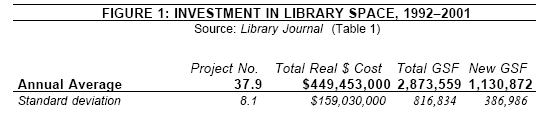
The 1990s were good years for higher education in the United States and for academic libraries. This was evident not least in the huge investments made in the renovation and expansion of existing libraries and in the construction of new libraries. Between 1992 and 2001, the higher education community spent on average some $449 million annually on library construction. On average, about 2,874,000 gross square feet of space were renovated or built annually.
At the same time that colleges and universities were making these impressive long-term investments in their libraries, they were experiencing at least two fundamental discontinuities with their past. A long-gathering understanding of students’ most effective learning behaviors was making itself felt in the adoption of active learning practices. Students everywhere were increasingly working in collaborative study groups of their own making, to engage more strongly and often more adventurously with their coursework. Recognizing the power of this mode of learning, many faculty members built experiential and problem solving materials into their courses and shaped assignments around the expectation of collaborative study. In these and other ways, the daily practices of learning and teaching saw widespread, fundamental change. Quietly but powerfully, American higher education acknowledged and began to engage with the social dimensions of learning and of knowledge.1
The second fundamental change, a revolution in information technology, was not at all quiet and was even more pervasive. While the pace of technological change has steadily accelerated since the 1960s, arguably the “take off” point came with the introduction of the World Wide Web in 1993. The Web in just a few short years gave everyone a reason to connect to the Internet and made connection relatively easy. By the end of the 1990s, information in the developed part of the world was networked. The impact on research and on libraries was profound.2 Complementary changes in teaching and learning were not slow to follow, not least because each year’s freshman class brought students to campus with ever-increasing facility with computing and heightened expectations that information technology would be a central feature of their education.3
The question this essay addresses is, “How did space planning for academic libraries during the 1990s address these fundamental changes in American colleges and universities?” In essence, this is a question about two quite legitimate conceptions of the library as a place. One of these, which has a long and worthy tradition, conceives of libraries as service places where information is held, organized, and managed on behalf of those who use it, who are often also directly assisted in their use of information by library staff. The other, which springs from a recognition of the essential social dimension of knowledge and learning,4 conceives of libraries as spaces where learning is the primary activity and where the focus is on facilitating the social exchanges through which information is transformed into the knowledge of some person or group of persons.
One can investigate the library spaces actually built or renovated in the 1990s to see what balance was struck between these two concepts of library space over the last decade. But in many ways, the space planning process itself-especially its earliest phases, where decisions are made about how a library project will be shaped so as to advance fundamental institutional concerns with learning and teaching-is even more informative. It is here that balancing decisions are made, consciously or not, governing how multi-million dollar investments in library space will focus on library services and on broader, institution-wide agendas in education. This essay describes the kinds of library spaces that emerged in the 1990s to respond to fundamental changes in learning modes and information technology. It also describes the planning processes typical of library projects and argues that higher education is missing opportunities to assert the community-wide ownership of library planning necessary for making new investments in library space highly productive for learning and teaching.
This essay also attempts both to understand the extent to which library planning has been conservative in concept, shaping our response to the future by extrapolating from past experience, and to identify key opportunities to interpose fresh visions of libraries that might produce space design decisions quite different from those of the past. Why does thinking “within the box” serve so well in the design of academic library space, and how might “thinking outside the box” serve even better?
A brief story may suggest the importance of the focus proposed for this essay. The provost of a European university was visiting parts of the United States in 2001, garnering ideas for the construction of a major new library building. The provost included Yale University in these visits and spoke with librarians there about their efforts to focus library space planning on student learning behaviors. The Yale librarians were attempting to design not an information commons, but something called a learning commons. The visiting provost immediately saw the point of the learning commons and said with some chagrin how little library planning at her own institution had been informed by thinking about student learning. The chagrin came from the fact that the provost’s disciplinary expertise was in education.
Clearly, the weight of traditional thinking about libraries at this provost’s university-and at many institutions in the United States-keeps planning focused not on the educational impact but on the service operations of libraries. Traditionally, library buildings are places where we shelve material, circulate things to readers, assist readers with questions about information resources, create instruments such as the catalog for navigating information, and teach readers how to master the complexities of both printed and networked information. Libraries also provide reading accommodations, but historically these accommodations are vulnerable to competing service functions of library space, particularly the need to shelve library materials. Library after library has sacrificed reader accommodations to the imperatives of shelving. The crowding out of readers by reading matter is one of the most common and disturbing ironies in library space planning.5 These outcomes must be acknowledged, in fact, to be a failure in planning. Such failures are the result of what the visiting provost saw so clearly: close attention in library space planning to library operations and unfocused attention-or outright inattention- to the learning modes of students and the teaching behaviors of faculty. This essay argues that as long as the accommodation of reader needs is narrowly conceived and secondary to provisions for library service operations, the full value of higher education’s investments in library space will go unrealized.
2. Planning Library Space to Advance Learning and Teaching
Writing in 1996, James Neal predicted that colleges and universities would increasingly direct limited capital funds to the renovation of existing library space and would avoid massive investments in new library space.6 This prediction sensibly reflected the keen competition for campus capital funds, the good economies to be secured through renovation, the diminishing emphasis in many libraries on technical services and the space they require, and?most importantly? the requirements of information technology for virtual rather than physical space.
It turns out that this eminently sensible prediction was wrong. What actually happened between 1992 and 2001 was a substantial and consistent level of investment in library space, year after year. As indicated in Figure 1, each year during this decade saw, on average, some 38 library projects completed. Taken together, these projects cost an annual average of $449 million (in 2001 dollars) and involved on average some 2.9 million gross square feet of space. Of this, new construction accounted for an average of 1.1 million gross square feet, or about 40% of the total space involved.7 There was no trend, either up or down over the decade, in this percentage of new construction. There was considerable variation in all of these averages from year to year, but the variations fell well within the range of a normal distribution of values.
In addition to spending nearly $4.5 billion on renovating or building new library space during the 1990s, the higher education community incurred substantial new costs for operating and maintaining that space. Putting operation and maintenance costs at $8 per square foot of space, and disregarding any increased costs associated with renovated space, the cost of operating new academic library space alone on average required at least an additional $9 million every year. These costs cumulate, so that by 2001 higher education had incorporated about $90.5 million of new operating costs into its budgets.
By these measures, there was nothing in the 1990s to indicate any slowing in new investment in academic library space. The age-old truth about libraries-that they always grow in size and demand more space-remained fully in force. It is hard to find evidence that breathtaking innovation in information technology and the “virtual space” it occupies slowed traditional investment in library bricks and mortar.
What motivated this consistently substantial, decade-long investment
in new and renovated library space?
A survey of library directors at the institutions making these investments asked this question. Situations at individual colleges and universities varied substantially, and several different motivators were frequently in play at each institution. But five factors, summarized in Figure 2,8 emerged as clearly most important for colleges and universities considered as a whole.
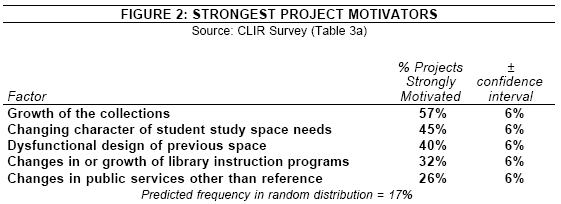
Survey respondents were asked to rank the strength of these and other possible project motivators on a six-point scale, with values ranging from “not a motivating factor” to “strong motivating factor.” A random distribution of responses would result in a given factor being a strong motivator only 17% of the time. All five factors in Figure 2 vary significantly from a random distribution, the first four occurring as strong motivators about twice or more frequently as one would expect in a random distribution of responses.9
Survey respondents also identified a number of possible motivators as not influencing their projects. These are shown in Figure 3:
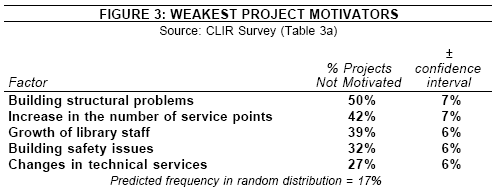
Here again, survey respondents identified these as non-motivating factors significantly more often than would have occurred in a random distribution of responses. The first four were identified as non-factors about twice or more frequently as one would expect in a random distribution of responses.
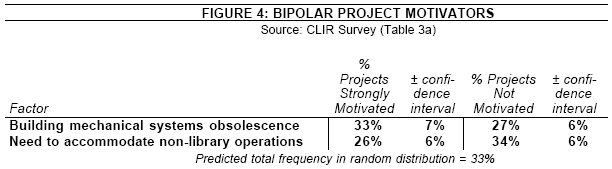
Finally, two factors figured in the survey responses in a bipolar way: i.e., they were both non-factors and strong project motivators almost twice as frequently as one would expect in a random distribution of responses. Figure 4 lists these bipolar motivators:
Judging from the absence of comments associated with many of these factors (e.g., collection growth, mechanical systems obsolescence), respondents regarded them as largely self-explanatory. Responses pertinent to some other factors indicated the particular meaning or application they had in individual projects. See “Accommodating Improved Library Services” on page 13 for a further description of these motivators.10
Aside from the factors described in Figures 2–4, the survey inquired about two other possible motivators: changes in reference service and the preservation of the collections. Responses to these factors approximated a random distribution, indicating that while these factors were important to some projects they were not significant motivators for the projects covered in the survey as a whole. The survey also asked about other possible motivators. Respondents mentioned the provision of improved space for archives and special collections and the influence of accreditation requirements a number of times. It is impossible to apply any statistical measures of significance
to these “other” responses.
The factors identified here bear only on library space planning and by no means exhaust the possibility for significant change in libraries. Survey responses to the question about changes in reference service as a project motivator illustrate this point. While there was unquestionably much ferment in the library community’s thinking about reference service in the 1990s, it did not figure as a significant
motivating factor in library space design, presumably because changes in reference service did not consistently drive new ideas for how reference space should be designed.
How might one understand these strong and weak motivators? If one is looking for factors most likely to motivate extrapolative planning,11 that is to say factors that embody traditional library operations,
they are found in the need to
- accommodate growing library collections
- correct for the dysfunctional design of previous library space
- effect changes in public services other than reference (given that these changes most often aimed at increased efficiency in traditional
operations) - overhaul obsolete mechanical systems
Factors that might, by contrast, drive interpolative planning?where the focus is on uses of library space that cannot be simply predicted from past patterns of use?were found in the need to
- accommodate the changing character of student study needs
- accommodate changes in or the growth of library instruction programs
- accommodate non-library operations
One may fairly conclude that traditional library needs were very strong motivators for the construction and renovation of American academic libraries in the 1990s.12 The weight of these traditional library needs will become all the more evident in the next parts of the essay, which consider what was built to satisfy these needs and the planning processes used to act on library space needs.
3. Library Project Responses to Motivating Factors
Accommodating Growing Collections
The survey of library directors did not ask whether additional shelving was actually a feature of their projects. The assumption was that projects in some good measure meet the needs that most strongly motivated them. A number of follow-up phone interviews with the library directors who responded to the survey indicated this assumption was appropriate.
The phone interviews provided information about how library directors and academic officers were thinking about collection growth in the 1990s. They had little choice but to consider this issue, as collections of print material continued to grow, just as publishing output grew.13 To accommodate this growth, new library construction and renovation in the 1990s provided shelving space for some 145 million additional volumes, with some 34% of that capacity provided in new construction (see Table 1). Clearly, traditional library needs had a very strong hold on library construction and renovation in the 1990s.
What are the prospects for change regarding this single strongest motivating factor and most traditional of library needs?
None of the 26 library directors interviewed for the study saw electronic publications as offering any relief from the pressure on shelving space as regards monographs, either now or in the foreseeable future. Most did comment, however, that the online availability of journals now offers and will continue to offer appreciable relief from shelving space needs. Library directors regularly commented on their newly acquired ability to remove back files of journals from prime shelving space or from their collections altogether. A number of directors specifically mentioned JSTOR, along with other publishers of electronic journals, as providing this leverage on shelving problems.
Some library directors mentioned designing specialized off-campus shelving facilities, often as a future possibility rather than as a present option for meeting shelving needs. There were probably only three specialized shelving facilities in the study’s database of 438 projects undertaken in the 1990s, and only one such facility responded to the survey. It appears from these limited data that the largest research libraries are investing in such facilities and that most of those built in the 1990s were designed for the use of a single institution, rather than as collaborative ventures among a number of institutions.14 Several directors at libraries with smaller collections expressed the wish to participate, sometime in the future, in a collaboratively managed shelving facility.
For many librarians, the prospect of off-campus facilities remains comfortably in the future; their strong preference for the present is to maintain collections on open, browsable shelving. The facilities manager at one large research library (Interview 11)15 spoke of having fewer than 10 years of collection growth space, even after a major renovation aimed at providing new compact shelving. He described the pleasure readers take in improved collection access made possible by recent renovations; the relief librarians feel in avoiding off-campus shelving for the present; and a resolve not to assume that such shelving will be the right solution to future shelving problems.
Indeed, a general preference was clear in the interviews for on-site shelving, whether of conventional or movable, high-density design. Most library directors tried to more than meet existing needs with such shelving, some seeking as much as 20 years of additional collection growth space. Though all library directors acknowledged the difficulty of predicting future rates of collection growth, none expressed willingness to forgo any of the shelving they could reasonably include in recently completed projects.
With present shelving needs met, most of the library directors interviewed for this study expressed little anxiety about future shelving needs. Few could imagine such needs becoming urgent during their tenure as directors. More important, many felt that-with burgeoning online resources and off-site shelving facilities a possibility- it was unlikely that shelving needs would ever again drive library space design in the way it had in the past. These directors sensed in the relaxing hold of collection growth on space needs some possibility for interpolating new ideas about the use of library space.16 The ambiguous force of such thinking was, however, evident in the view of one liberal arts college dean (Interview 6) that it was quite possible in the next 20 years for pressure from the college’s growing collections to displace reader accommodations, as it had before.
It certainly could [happen]. It’s probably 10 years down the line . . . but I could see that happening. . . . It’s just the realities of working within a fairly tight budget. . . . One of the things that happened when we got done with the renovation and expansion is that the space got so much more attractive that the number of visitors [i.e., readers] simply doubled or tripled. It went way, way up. And so the question is, can the library if it gets significantly more full [with print material] still accommodate that number of students? And it will be difficult.
Library directors and chief academic officers alike observed how commonly in the past the need to add shelving crowded readers out of library buildings. In this way, libraries became ever more simply places to house printed collections. When choices were forced, shelving the collections has been more important than maintaining reader accommodations. New construction and renovation are commonly designed to counter-for shorter or longer periods of time-this apparently unstoppable tendency of the collection to consume space and, ironically, to drive readers away from libraries. It is going to take more than a decade of experience with electronic publications and alternative shelving practices to free higher education from the threat that print collections pose to good libraries. There is evidence that many involved with library planning hope a process of gradual change has moved us past the point where this familiar cycle of behaviors will entrap us again. But there is little evidence that the higher
education community has reached the point in its thinking about libraries where it is ready to affirm that readers will assuredly have first claim on space even when space becomes highly constrained by collection growth.
Accommodating Improved Library Services
Library projects in the 1990s were designed to meet a host of operational
needs beyond that of shelving collections. As indicated in Figure 2, the single most frequently expressed such need was for space to support the library staff’s instructional activities in information literacy and staff development. The need for electronic classrooms has become so apparent that survey respondents felt little need to comment on anything beyond the number, size, technical capabilities, and use policies for such instructional spaces.17
Figure 2 also indicates that library projects in the 1990s were strongly motivated by the need to accommodate the delivery of public services other than reference. Survey respondents described numerous public service activities-prominently including circulation, interlibrary loan (ILL), and special collections-that benefited from new or renovated space. The automation of library functions and concomitant changes in workflows were often mentioned as factors that motivated capital projects. Respondent comments suggested renovations rarely reached beyond the operational needs of individual library departments in their consequences. The comment of one doctoral university respondent typifies the description of these operational goals:
[We wanted] to consolidate access services functions to reduce service points and to better utilize both space and staff. For example, we felt that reserve processing and ILL services should be adjacent to one another to maximize the use of equipment and staff. We envisioned using reserve staff to assist ILL staff in ILL during the summer and during other slow times in course reserve processing. We also envisioned using ILL staff for copying and scanning course reserve materials during Reserves’ peak times. We have been able to make these staffing changes work because of the reconfigured spaces.
There was also some need to accommodate non-library operations in library projects. As indicated in Figure 4, such needs produced a bipolar response. Significantly more respondents (25±6%) than one would expect in a random distribution indicated that the need to accommodate non-library operations was not a factor in their planning, while at the same time significantly more than one would expect (34±6%) indicated it was a strong motivator. Respondents mentioned media services, academic computing services, centers for instructional technology, centers for teaching and learning (often but not necessarily rooted in instructional technology), and student writing centers as academic operations not administered by the library but sometimes housed in library buildings. Interviews with library directors suggested that decisions to place these functions in library buildings were most often simply pragmatic-i.e., library space existed or could be created for these units-rather than a product of strategic collaboration between such units and the library. Strategic partnerships can indeed develop out of the experience of library and other academic staff working in close proximity with one another, but such partnerships seem most often to develop after the fact and slowly.18
By far the most common provision for the changing operational needs of libraries was to design for as much flexibility in future uses of space as possible.19 Some 72±6% of survey respondents said their projects provided for future changes in space use, a figure substantially above what one would expect in a random distribution of responses. Survey respondents frequently mentioned open, modular floor plans, floor loading capability for both conventional and moveable shelving, pervasive conduits for electrical power and telecommunications, and flexibility in providing networking technology as key strategies for meeting future, mostly unpredictable, needs. One respondent at a master’s degree institution commented soberly that such flexibility in providing for an unknowable future comes at a cost, and that “budget realities forced us to cut back somewhat on flexibility.” Costly as such flexibility may be, the certainty of change makes it a good investment. Some 61±6% of survey respondents reported
having experienced the need to make further space changes relatively soon after completing their projects (Table 4a, question 13).20 Several respondents described the benefits already realized from flexible designs, one of them from a doctoral university saying that “flexibility was a big issue, thus, big open floors not filled with stacks has been a big boon. We have moved services, technology, and collections multiple times since completion [in 2001].”
Beyond specific operational needs, planning for new and renovated library space commonly aimed at accommodating broad shifts in information technology. The comment of one respondent from a master’s degree institution explains the importance of such planning:
[We had] a tremendous need to transform a 1960/1970s facility into a twenty-first century academic library. The library renovation and expansion project was as much about preparing for new technologies as it was about our need for additional space. This gets a #5 [i.e., a strong motivation rating in the survey]!
Survey respondents often commented on efforts to link print and electronic resources by locating workstations in the midst of print collections; to provide readers with ubiquitous connectivity through wired or wireless systems; and to develop information commons that provide workstations with a variety of information management software and access to broad-ranging information resources. Taken together, such efforts could go some distance toward changing a library’s authority on campus and its image of itself, as another respondent from a doctoral university made clear in describing the impact of a major consultant’s study of information technology:
That report from an outside group made it possible for the library to have influence that it would not otherwise have had. The campus had made the decision to focus on technology. This provided somewhat of a blueprint. And I think frankly it allowed the library to present a picture that was not entirely dependent on the campus computing center’s perspectives, which were probably not as ambitious as were [those] involved in this report. . . . [The report] really changed the nature of the conversation rather than making any specific recommendations. It really positioned the library to be a different thing than it would have been, in the way the whole campus thought about it, rather than the specific projections on the technology. . . .
Importantly, the library went from being a small under-funded library at a second tier university to one of the most technologically sophisticated academic libraries in the country. Over several years the library’s conception of itself changed to view itself as a leader. The new building and the technology that came with it in many ways transformed the whole library’s view of itself.21
The architectural challenges involved in making the changes described here, though surely important, are nonetheless relatively ordinary: attention to adjacencies, the more effective use of space, designing to support efficient workflows, open floor plans, and robust telecommunications capabilities. Success in handling such commonplace design issues can pay remarkable dividends. Library operations become notably more convenient and more efficient for readers and staff alike. Due especially to the capabilities of library management systems and the provision of online information resources, readers are no longer required to visit the library to discover and make effective use of information. They readily command immense library and other information resources in their offices, laboratories, and residence halls, at home, and even on the campus green. Readers have embraced the virtual library and value it highly. In the 1990s, libraries dramatically enhanced their utility by moving much of their services into virtual space and reducing the necessity of using actual library space.22
Accommodating Students’ Need for Learning Spaces
Libraries succeeded so well in improving their services and supporting electronic information resources that many-especially those asked to pay for it-began to question the need for bricks and mortar library space. The dean of a liberal arts college (Interview 6) wanted particularly to counter the view that libraries as places are becoming obsolete because of the emergence of information technology. He wanted to protect the idea of a traditional library as a vital component in the life of the college. “There are voices out there that would tend to feel that the library is something of an albatross around an institution’s neck, and that’s not the case at all.” Understanding better the behaviors of those who continue to make frequent and significant use of library space, especially students who are by far the most frequent users of library space,23 and responding to those needs became an important counter to the skepticism voiced about the value of library space.
The dean just quoted argued that the library is “probably the most important place for learning on campus. . . .” Recognizing this value, the study survey asked a number of questions about the ways reader accommodations, and especially student accommodations, were improved. These questions were not concerned with the direct operational needs of libraries (for instance, to shelve its collections or improve circulation functions), but with the need to accommodate the learning behaviors of students. These questions were asked to help understand how library design in the 1990s responded to the needs of students not simply as users of information but more broadly as learners.
Asked about student learning spaces, library directors reported providing group study space much more frequently than one would expect in a random distribution of responses (see Table 4a, question 7).24 Interviews with library directors and academic officers suggested that the need for such space became newly apparent to them during the 1990s, as they consulted with students and observed what succeeded in other library projects. Tellingly, one research library project (completed in 1996) that was strongly oriented toward students nonetheless missed the importance of group study, at least in one respect, and had to reconfigure its space after the fact as student preferences became apparent. The institution’s chief academic officer (Interview 1) affirmed that the project was informed by a
deep conviction . . . that students would drive the evolution of this facility. . . . And for many years, we’d had the philosophy in other parts of the university that you build a very powerful and flexible environment, and then you let the students shape it. So for example, when we first built the place, we built it in the traditional way in which each student would have their own workstation and so forth. And then we began to realize that’s not the way students work these days. They work in teams where three or four students will gather round, and they have three or four workstations. So we reconfigured all of that, to let the students define how they learned and how they approached their activities. . . . We felt that if we built the space, and did it in a flexible way, the students would define their own learning environment. I think that’s what’s been happening.
The library director at another doctoral university (Interview 12) spoke with obvious pleasure of the way his project enables effective student learning:
Just the most notable thing about usage is . . . the extreme growth in group study. . . . We’re seeing that virtually all of [some 250 tables seating four to six students] are filled with students working together, and . . . the thing that makes us happiest is that we somehow stumbled into a really high-use kind of thing here that reflects how people function within their classes and work with their fellow students. . . . [This space] will be filled, literally every chair, . . . and they’re all talking at the same time. And the hum that rises above this is just amazing. And they don’t care. . . . There’s all this din that occurs [from] hundreds of students in this same space, all working together and all talking at the same time. Immediately adjacent to a typical space like this is a space with like 60 computers, and they’re all clustered around the computers as well, working together in some cases. Somehow it just all came together as a very useful space for students. . . . We just beam with pride. Every time I come down the elevator to leave, and I see these hundreds of students out there-that just never happened before.”
Group study space was the only kind of student accommodation that respondents mentioned more often than would occur in a random distribution of responses. Other student-oriented spaces (e.g., computing laboratories,25 conference or other information meeting space) did, however, figure in the responses, as did traditional ways of meeting student study needs, such as carrels and general purpose or subject- or format-specialized reading rooms. Several respondents described accommodations provided for students with disabilities. One library director at a master’s degree institution emphasized the need to accommodate a variety of student learning modes: “We pride ourselves on creating as many different study environments as there are ‘study styles.’ Large and open, small and intimate, lots of sunlight, low light, etc. etc.”
Two other kinds of space directly responsive to student needs deserve mention here: space for social purposes and for food. The view that food should be kept out of libraries seems largely to have collapsed in the 1990s. Survey respondents reported that 50±9% of the projects included vending machine food and beverages, while 23±8% reported including staffed food services and another 27±8% reported some other type of food service. The provision of vended food occurs more often than one would expect in a random distribution of responses (see Table 4a, question 9). It would seem that new library construction or renovation now regularly provides some kind of food service. This surely responds to student desires (often expressed in defiance of library rules against food and beverages) and to the practices of some bookstores. If one acknowledges the social dimensions of learning and knowledge, the provision of food-so often strongly associated with social activities-seems quite appropriate. One respondent at a doctoral university commented on the extraordinary success of its library’s food service:
Three years ago . . . the library built a donor-funded café serving beverages, espresso, sandwiches, pastries, and grilled sandwiches. The café is open 90 hours a week and 24 hours [a day] during finals. An outside vendor is operating the [café name]. The café is proving to be the most successful on-campus food operation.
The social dimensions of learning and knowledge found many other architectural expressions in projects of the 1990s. Survey respondents frequently described entrance lobbies and atria, group study rooms and other study areas, computer laboratories, and lounges as social space. Other responses indicate a wide variety of spaces (from elevator lobbies to rooftop gardens) are used as social space. Several respondents mentioned outdoor spaces adjacent to the library as having been built and landscaped explicitly as social spaces. It is clear that students will create social spaces for themselves, whether or not space is designed for this purpose. A respondent at a doctoral university commented that “in the old library, social groups making noise were disruptive so this activity was designed out of the new building. The students of course found their own way to socialize and noise is an issue.” Another respondent at a master’s degree university happily affirmed that “I consider the entire facility a social space for students.” Still another respondent at a doctoral university reported that “fortunately or un[fortunately], the entire library has become a huge social space. Our usage is soaring, it is hard to find a seat at many times, and we are a most popular destination for our students.”
This last comment suggests some ambivalence about the library being so popular a social space among students. Statistically, survey respondents reported providing social spaces for students some 47±7% of the time, close to what one would see in a random distribution of responses. Ambivalence about concepts of the library as a place for individual and for social study is more evident in a separate survey, conducted in November 2001 among library directors and chief academic officers at institutions belonging to the CIC (see Tables 6a and 6b). Respondents at these typically smaller, tuition-dependent institutions agreed strongly only 16±7% of the time that socializing among students (without food service) should have high priority in existing library space. This view was expressed much less often than one would expect in a random distribution of responses. The same respondents, however, assigned high priority 26±8% of the time to such socializing space in any new library space that might be created on their campuses. And while most of these respondents (41±10%) gave social space only medium priority, the upward shift in priority for the social uses of existing and new library space may suggest a growing acceptance of the importance of the social dimensions of learning and knowledge.
Thinking about the library as a social space, rather than as space primarily for undisturbed reading and individual study, involves some recasting of ideas about what makes for success in library planning. The importance to students of this recasting was strikingly evident at one liberal arts college, where the library director (Interview 25) reported there had been no place on campus for students to study together, except the dormitories, which did not work well. Students, he said, were sitting on hallway floors and in vacant classrooms. They “wanted to come together in some other place, and in fact they do come together now [at the library]. This is both a very social and a very studious library. . . . . And it’s been that way since we opened up.” In their behavior, students at this college and elsewhere have affirmed quite decidedly there is no contradiction in thinking of the library as both a social and a studious place.26
4. Project Planning Methods
Recognizing the importance of the initial steps in project planning, institutions engaged seriously with various assessment, goal-setting, and programming activities. Significant variation in these activities is, however, apparent. One respondent at a general baccalaureate college commented that “we had done . . . [assessment] activities as a matter of course,” while another respondent at a doctoral university reported that “very little time [was] given to assessment, due to the press of work and the small number of staff members.” A number of respondents distanced themselves from the survey’s emphasis on systematic assessment by describing their planning as “thorough” or “extensive,” if not “systematic.” This comment from the library director
at a doctoral university typified such caveats:
While we could not claim to having done formal assessments, we certainly spent time analyzing not only the present but also the future trends in student learning, teaching, and . . . learning spaces and learning technologies. Our goal was to be ahead of the curve and proactive-not just a responder.
Follow-up interviews with library directors made it clear how informal many assessment activities were.
Figure 5 lists the planning methods survey respondents reported using significantly more often than one would expect in a random distribution of responses.
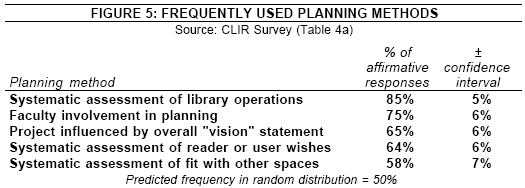
By far the most frequent planning method was the assessment of library operations. Survey respondents describe surveying faculty and student opinion about operations, projecting collection growth, identifying appropriate environmental standards for preserving collections, studying adjacencies, and doing environmental scans-especially of information technology. These assessments were sometimes done by or with the assistance of a library consultant. Site visits to other libraries, reference to library space standards set by the Association of College and Research Libraries (ACRL), and statistical comparisons with peer institutions were also mentioned as means of systematic assessment.
To meet needs without wasteful duplication, library projects were often planned with reference to other spaces available on campus, especially student gathering spaces, auditoriums, and computer laboratories. Survey respondents reported planning the library as an element in a larger plan of campus accommodations 58±7% of the time, a rate that differs just slightly from what one would expect in a random distribution of responses.
As Figure 5 indicates, faculty were regularly involved, especially in the preliminary stages of planning, when project goals were determined. Commonly, such involvement was achieved through standing library advisory committees or committees appointed especially for the building project. Normally, students served on these committees as well, but their involvement appears to be less certain and their impact less significant. Some 51±7% of the respondents reported students being involved in space planning, a rate indistinguishable from a random distribution of responses.27 Many survey comments indicate that faculty and student views had little impact on the planning process; no comments identified faculty or students as having a major impact. One librarian at a liberal arts college (Interview 26) commented that both faculty and student representatives on the project planning committee showed little significant interest in detailed planning, attending meetings only when the architect made presentations. The role of faculty in library planning is described more fully in section 7.
Some 65±6% of survey respondents reported that their projects were meaningfully influenced by an overall vision statement describing the library’s mission and services. These documents are typically the products of substantial planning exercises that can be either independent of library space planning or integral to it. Vision statements commonly serve to explain and validate the library’s mission and win broad adherence to that mission within the academic community. 28 In actuality, by far the most important audience for such statements is the library staff that develops them. Other audiences include the faculty and student committee that commonly advises the library director, the administrative officer to whom the library reports,
and—where appropriate—those charged with space planning.
While vision statements typically assert the centrality of libraries to academic life and the role libraries play in supporting teaching and learning, these statements are rarely informed by any systematic assessment of how students actually learn or how faculty teach. The same is true of space planning. Figure 6 lists the planning methods respondents reported using significantly less often that one would expect in a random distribution of responses.
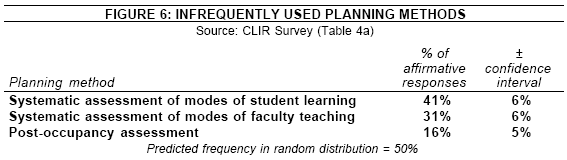
It is regrettable that library claims to support learning and teaching are so rarely backed by any formal, systematic understanding of these most fundamental activities of higher education. Interviews with library directors made clear that even when, in the survey, the director had affirmed doing a systematic assessment of student modes of learning, what had typically been done was a survey of student preferences regarding group study space and types of seating.
Although it spends hundreds of millions of dollars every year on building and renovating library space, the academic community in America rarely feels the need, as Figure 6 indicates, to undertake any formal post-occupancy study of the success of library projects.29 No doubt the daily experience of working in and of serving readers in new or renovated space provides telling evidence about project success. And library directors are not slow to recognize the need for further change. As noted on page 14, some 61±6% of survey respondents reported the need to make further changes in their libraries relatively soon after the completion of their projects (see Table 4a, question 13). The data most commonly cited to support claims of project success are counts of people entering the library. These and library circulation figures often increase dramatically after the completion
of a library project.30 These figures often match campus-wide changes in the perception of the library as an object of institutional pride and as a prized means of advancing teaching and learning. The library director at a master’s degree institution (Interview 21) proudly reported that “one faculty member said to me, . . . this [renovation of the library] is the best thing to happen to students on our campus in 30 years. And I think that’s absolutely true.”
5. Character of Planning Methods and their Outcomes
Was library space planning in the 1990s still primarily extrapolating on past experience, in the belief that the only prediction about the future that could confidently be made was that it would look rather like the past? Or was planning in some way attempting to interpolate a significantly different vision of the future and hoping to bring that future into being through planning decisions?
It appears from the survey data that library space planning was still primarily extrapolative, responding strongly to traditional needs and ideas of library service.31 To test this perception, the following proposition and questions were put to the library directors interviewed for this study:
Survey results indicate that while changes in technology frequently drive the need to reconfigure library space for specific services and operations, there is relatively little fundamental rethinking of the need for and uses of library space. Aside from the omnipresent computer (often presented in clusters), group study space, and electronic classrooms, library space today has much the same character and basic function as library space built a generation ago.
- Do you agree with this characterization of your project? If not, how would you modify it?
- Should we expect major changes in library space design to evolve in largely incremental and experimental ways, building on what we know has worked well in the past?
- Are there opportunities to break with an evolutionary process of library design and adopt more radical, revolutionary, and possibly risky views of what library space should be?
The phone interviews did not always adhere closely to their script, with the result that only 21 of the 25 library directors (84%) interviewed were asked these questions, and of them 19 (76%) responded in ways that were directly pertinent.
Nine library directors affirmed that the projects they had helped to plan were intentionally aimed at traditional needs and designed to affirm the traditional identity of the library. Seven others offered “Yes, but . . .” answers, saying that the proposition fit their library project, with only some qualification. Only two library directors described their projects as aiming at and achieving some fundamentally different vision of the library. One respondent (Interview 14) reported that efforts to reconceive the library as a “teaching library” had failed. Staff members were not enthusiastic about the idea and were glad to see this emphasis die with the departure of the library director who advocated it. “Looking back on these efforts, they now seem linear—i.e., as reasonable and predictable lines of evolutionary development. At the time (very early 1990s), they looked more revolutionary.” Those affirming traditional purposes in planning were clear about the values they hoped to achieve. The library director at one master’s degree institution (Interview 20) said:
We built a very traditional building. We sought to provide comfort, quiet, light . . . and convenience—and that’s what was missing in the old building. A lack of comfort, I think, if I could sum it up in one word. It just wasn’t attractive, it didn’t feel good to come in; people used to tell us they were doing fine until they got an assignment that made them come into the library. . . . Our design has worked magnificently. And we get compliments constantly about the way the building feels when they come in. [So we] satisfied some basic human need for comfortable space to sit, to focus and concentrate. . . . I also see faculty who actually come . . . [to] hide out over here. Never did that before! So we’re meeting a need for things other than the computers and wireless networks and group study and conference rooms.
Another director, at a liberal arts college (Interview 25), made the same point, emphasizing the communal function of the library:
Libraries are [often] very gloomy; they’re not very nice places. They’re not attractive. . . . Why shouldn’t students have decent light and a comfortable chair and a clean environment and room to spread out their materials so they can work? And also to be able to see their friends when they’re there? You know, this is their community now. They’ve left home; this is their world. And so I think that’s what we’re providing them: a place where they can develop and grow.
Another director, at a doctoral university (Interview 9), described the effort to design the library as a campus crossroads, open to a variety of activities not managed by the library, as aimed at traditional values. “We’re designing to functions that I hope will still be embedded in the library of the future, in terms of intellectual and social commons for students and faculty.” One other director, at another master’s degree institution serving one of the nation’s largest cities, described the result of providing readers with library space that is both comfortable and handsome:
The building is so unbelievably gorgeous, and so majestic; it’s so grand. . . . If you came to our building, I’m sure you would be in awe. It is like what a grand, wonderful library should be. . . . It has an impact on what people do when they’re in the building, how they feel. . . . It’s a very important statement for the college to make. It’s the most democratic building on campus, and if it’s grand and awe inspiring and at the same time warm, comfortable, and inviting, it makes a tremendous statement about how the college feels about learning and teaching. Our president has said that for [the institution’s name,] the library is an article of faith.
Notably, these champions of the traditional library speak compellingly about reader accommodation. While survey results indicate that accommodating print collections was the single most powerful project motivator in the 1990s (see Figure 2), it is reader accommodation that seems most powerfully to define the traditional library.
Most of the library directors who responded with “Yes, but . . .” comments qualified their affirmation of traditional purposes by describing efforts to provide supportive environments for the use of information technology. Actual changes in library spaces focused on computer clusters, information commons, and decisions about adjacencies between print collections and computers. Two institutions reported diametrically opposite results in bringing print and electronic resources into close proximity, one having to abandon the effort after the original project design proved a failure. The director at a regional campus of a doctoral university commented that while no effort was made to design a radically different library, and while conservative attitudes among some faculty inhibit radical change, it is nonetheless possible to advance significant change: “If we infuse technology into library space, we affect perceptions of people in the environment. We position the library in a way that it can be seen as a leader in the intelligent adoption of technology for use within the community.” The effort here is to change perceptions not of library space but of the library as an organization.
A librarian at a liberal arts college (Interview 28) described the first phase of their renovations as aimed at traditional needs, while the current phase pursues a significantly different view of the use of library space:
We are changing with this renovation from an old fashioned library where the client comes in and consults with the librarian or consults with a computer to get some information and then goes off to do whatever they’re going to do. What we are planning for and implementing right now is space that supports a student who comes in and wants to start her research in the reference area. So she sits down at a spacious table with a computer. She spreads herself out and she goes to work. She does her work. She starts her writing. She talks with a reference librarian and so on. So she’s there for the duration. . . . Just a few steps away is a very large reading room. And this really defines the change too. Before the renovation it had been stack area. . . . After the renovation, . . . this area is becoming a large reading room which is going to have vending machines with it so that students can go in and relax a little bit, can eat, can do their work, and at the other end of the room they have newspapers and current periodicals. So while the standard resources are still here, the way we allot the space and place our service points has evolved.
The interviews suggested some experimentation in designing space to support readers deeply engaged with electronic information resources. The library director at a doctoral university (Interview 13) described the uncertainty and the importance of such planning, given the amounts being invested in library and other buildings:
What we’re trying to do is to figure out the physical requirements, the space requirements . . . [for] the new role we see the library playing in terms of the creation and management of digital information. The need to educate and train students and faculty on use of the technology and the ways of creating new digital products are all things that we’re trying to think through in terms of space requirements in the new library. We don’t have the answers there, and we haven’t found anyone who has the answers. The architects aren’t helpful, because it’s not an area where they’ve had a whole lot of experience. What you describe [i.e., traditional library design] is exactly what we see around us in terms of how other people have gone about thinking about the technology piece of what they’re doing. And we’re looking for some better support, some better advice. It’s part of a larger campus problem that I’ve identified here everywhere. There’s a tremendous amount of construction going on on this campus right now, compensating for 20 years of neglect on academic facilities. And there is such a huge disconnect between the architecture—the design of the space—and the technology piece. Those two pieces have not been brought together.
Vital as the effective accommodation of information technology is, it arguably should not be the dominant concern in planning new library space. The library director at a liberal arts college commented,
in a follow-up message after the interview, that
there is a strange dialectic right now (at least since the mid-1990s) between libraries and technology that we in the profession have not worked through. I[‘m] thinking here not just of the print/electronic nexus but also the notion of a library as a space for thought, reflection, study, and active learning. . . . In planning new spaces, we should have . . . [this second set of issues] foremost in our minds. But it’s hard, because many on our campuses really just want us to solve [i.e., eliminate] the ‘space problem’ rather than begin the process of rethinking the role of the library in positive, proactive way.
The same library director (Interview 29) commented that technology sometimes drives library design for the worse, producing libraries that are over-designed for technology. “Technology was not the solution
to our problem, and we really need to let the teaching mission drive the process. So we listened closely to the faculty, and we tried to listen to students.”
Only two library directors reported success in a significant reconceptualization of the library.32 In one case, at a doctoral university, this was the result of the chief academic officer’s leadership and his insistence on the value of proximity and integration among information resource units. This person—described by the library director as the “godfather” and “guardian angel” of the project (Interview 8)—insisted that the library and other technology units share the building without having their own discrete spaces.
In the planning process for this building, . . . the library was uncomfortable with basically being in a building that had such a large non-library presence, and probably felt a little threatened by that, and at one point said, ‘Well, just give us our space, and we’ll take care of designing that; you [other] guys can go do whatever you want to do.’ And that clearly was not going to be the way this was approached. It wasn’t until the library gave that up—and a lot of preconceptions were dropped by everybody, really—that things became much more integrated.
The result was that “space in the building was designed to be shared,” making it imperative that people from different disciplines and different administrative units work “side-by-side.” The result is that one often cannot tell what physical space “belongs” to what program. The library director exemplified the benefits of these arrangements by describing the interaction of library staff with another unit’s software evaluation staff: “Proximity is, of course, the thing that really does it more than anything else. Proximity to the special things that exist in this building as well as proximity to the other staff.” The chief academic officer (Interview 1) described the building as a “creative space, built around creativity and technology” and speculated that “when the building finally came on line . . . my suspicion was that there probably weren’t over a dozen people in the university that had the foggiest idea what it was.” Significantly, the building has been immensely successful with students but has had uncertain success among faculty:
Part of the challenge is to get the faculty comfortable with coming in to this non-traditional kind of space. Students have no problem with it; they take to it like ducks take to water. They walk in, and within half an hour have found what they need. . . . They navigate very easily. Faculty are very intimidated, particularly because there are so many students in the building all times of the day and night. So we haven’t quite figured out how to get faculty here and engaged in it, and by faculty I also mean faculty bringing in their graduate student research teams. And I’m not quite sure what we need to do with that yet. . . . We may try some experiments.
The other library director who described an intention to counter traditional values in planning her library serves at a general baccalaureate college (Interview 31). She described her planning as follows:
We didn’t start out with what I think is the traditional question, ‘How much stuff do we have to get in this building and what kind of stuff is it?’ . . . We didn’t do that. We started out the planning by saying. ‘What do we want to happen in this building?’ And the answer to that was that we wanted to be much more proactive about promoting learning. . . . And that’s what we were trying to do—both information literacy, which we consider our discipline, but also other kinds of learning—and we wanted the architecture to make it be like a think tank atmosphere, where there would be lots of exciting ideas bouncing around, and people could interact with each other and text and whatever technological stuff they might require, so that great minds could do their thing in this space.
This library director described a planning session with an architect, a consultant, the college dean, a faculty member, two regents, and an information technology specialist as
an amazing experience. And that’s when we came up with the whole notion that we have three things coming together in this building: we have learners, experts, and tools. And this is the only place where that particular combination comes [together]. Tools you can get anywhere now, and learners can be anywhere and should be anywhere. But experts are not quite so mobile—both librarian experts and classroom faculty experts. But where we all come together is right here in this library.
It was far from clear how best to design space to exploit what makes the library unique on campus:
We tried to find literature about the design of educational spaces . . . . I was amazed; I found next to nothing, and I thought surely school designers must think about these things, don’t they? But I couldn’t find anything. I was trying to find out more things about learning styles. We knew we wanted to accommodate many different kinds of learning styles here. . . . But we didn’t have a lot of guidance from anything except our own sense as learners and teachers of what people might need. We hoped if we provided enough different kinds of spaces, people would find ones that were convenient for them, or conducive to their own styles.
The library director described herself and her colleagues not as information “handmaidens,” waiting for readers to ask for help, but as educators. The embrace of the educator’s stance was “completely obvious” for them, as was the desire “to say with the architecture that this [library] building is not about stuff; it’s about people.” To foster this view, one needs “librarians who think differently. And I’m afraid I haven’t seen a lot of those. I hear a lot of librarians being concerned about our relevance in this age. . . . That’s a serious concern, but we’re not going to answer it by doing the same old things we’ve always done.” Doing something unusual met with little opposition from college faculty or administrators. Indeed, the library director said she “felt really lucky in the whole process that the administration was actually willing to go out on a limb with this building. And they were not only accepting of some different things to do but really eager to do some different things.”
The comments of other library directors suggest how unusual the two planning processes just described are. This librarian, at a liberal arts college (Interview 27), observed that
Facilities are very expensive. It’s hard to figure out how to experiment. . . . We’re going to be fairly conservative about that. At least in the college library, what you’re going to do will be in response to what you think is happening in the curriculum and the way students are going to use information resources in the next five to ten to fifteen years—whatever your planning horizon is. That’s about as far as you’re going to go. Those changes in curriculum and so forth are fairly conservative, fairly slow to happen.”
The library director at still another liberal arts college (Interview 26) expanded the point, arguing that the general environment of higher education has a conservative influence on library planning: “There doesn’t seem to have been a paradigm shift yet [in library space design]. It seems to me that higher education in general does not seem to have paradigm shifts very often. So since other things change so slowly, it may be only natural that libraries do.”
This picture of library planning outcomes during the 1990s is mixed, though perhaps less mixed than one would wish. Most of the library directors interviewed for this study, whose experience with projects gave them a well-informed basis for judgment, affirmed largely traditional goals for their libraries. One can hardly quarrel with those goals, especially as they focused on improved accommodations for the readers who had so often been crowded out of the library by growing collections. There was in the 1990s some experimentation in designing library space for the effective use of information technology, but most library directors felt these efforts only qualified but did not fundamentally change the traditional character of library planning and the outcomes of that planning. Efforts to interpolate a quite different vision of the future of libraries into space planning were apparently rare—though successful in the two cases identified in this study.33
6. Choice of Architect
This study did not collect data on the way architects themselves might influence the extrapolative or interpolative character of library space planning or the outcomes of such planning. Passing comments made by library directors and academic officers indicated high levels of satisfaction with architects. Survey and interview comments warmly praised architects who were attentive to client wishes, suggesting that few architectural firms attempted to reshape the character of space planning where a client was predisposed toward a given planning stance.
Architects are often, but not always, closely associated with the early stages of planning. Libraries are sometimes part of a campus-wide planning effort typically conducted by specialist architects; libraries may also sometimes benefit from campus-wide surveys of building conditions or from a survey focused on the existing library building. The point at which architects most frequently become involved with the academic and other goals of a particular library project is during the actual programming of the project, the stage at which programmatic and adjacency needs get their first conceptual statement, before any design work is undertaken. Early engagement with the architect in developing a deeply shared understanding of the project is critically important to a good match between goals and design decisions; it is equally important in avoiding costly false starts in design and still more costly change orders after construction begins.
This study identified the lead architects for most of the library projects completed in the 1990s. As Figure 7 indicates, architects were known for 388 of the 438 projects (89%) identified in this study. There were 279 different lead architects or architectural firms associated with these 388 projects; architectural firms collaborated on a number of projects, but lead architects only are tabulated here.
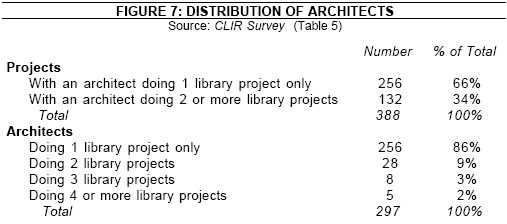
It is striking that 66% of the projects were done by architects who had no other library projects in the study’s database, with such architects accounting for 86% of the firms commissioned to build or renovate libraries. Library planning in the 1990s clearly had the benefit of a great variety of professional experience. These figures do not suggest that the selection of architects would itself produce any monotony of thinking about library planning or design.
Just as striking is the evidence of how narrowly focused among architects is substantial experience with libraries. Only 5 firms, among 297, were the lead architects for four or more projects completed in the 1990s.34 These 5 firms took the lead with 52 projects (some 13% of all projects in the database). If experience matters in library planning and design, as it does in other professional activities,then relatively few projects in the 1990s had the benefit of lead architects with substantial experience. Such experience is doubtless a competitive advantage from the architects’ point of view. From the point of view of the vast majority of institutions that are unlikely to secure this degree of experience in their library architects, it would be important to find ways to learn as much as possible from the example of architects having wide experience with libraries. The responsibility for identifying and acting on opportunities for such learning lies, surely, with the library profession itself.35
7. Ownership of the Planning Process
The chief academic officers and other principal administrators interviewed for this study identified an important and distinctive characteristic of library space planning. Unlike other academic buildings, faculty do not assert an owner’s right to control library planning. This opens the door for others to own the planning process. The dean at a liberal arts college (Interview 6) explained the matter as follows:
The library planning is almost more like the campus center planning we had. . . . It’s a common space; it’s not anyone’s space in particular. And so as a result, people such as myself have more of an opportunity to make an impact than in . . . [academic buildings in the sciences and arts], where it [i.e., the new building] is . . . sort of owned by the faculty members in that particular discipline.
Many library directors would say that, on the contrary, virtually everyone asserts owner’s rights to influence planning, so that building or renovating a library necessarily involves a complex and normally prolonged process of negotiation.
Of course, academic buildings always require negotiated decisions about priorities, project budgets, sites, and, often, exterior appearances. Decisions on these matters are seen to affect many campus interests and must for that reason be made as institutional decisions. But beyond these matters, the occupants of a building normally claim an owner’s right to have their views deferred to on anything that will determine the building’s success in meeting its academic goals. What do the interviews conducted for this study indicate about the assertion and management of ownership roles in library space planning?
Chief academic officers not surprisingly focus first on their financial responsibility for library planning projects. Such responsibilities normally include enabling decisions that set the project’s priority among competing claims on capital resources and ensure funding for the project.36 These decisions are sometimes made in the context of larger plans for campus-wide renovation. On occasion, project decisions are part of a disappointing history of false starts. One president (Interview 5) spoke particularly of his responsibility to overcome a long history of being rebuffed by the state for capital funds for the library. Academic officers commonly avoid detailed involvement in a project. The executive vice president of a doctoral university, for instance, described himself as “an enabler of sensible academic plans. I tend not to get involved in the details, but I feel empowered to reject them out of hand if they’re silly” (Interview 3). Academic officers rarely asserted other roles in the interviews, even when they played them. Where the library director at a doctoral university described his chief academic officer as the “godfather” and “guardian angel” of the project, that officer himself (Interview 1) confined his role to that of appointing a good planning group. The creativity of the planning was, he said, “very much grass-roots driven. It came from some really creative faculty and some very creative deans, and my particular role at that point was to make sure they had the money and to get out of their way.” He did, however, strongly encourage the planning group “to push to the limits, to take some risks.” Generally, library directors and academic officers agreed on the vital but limited roles of the latter in library planning. The library directors interviewed for this study, who had all completed projects, spoke of having invaluable support from institutional officers, but very few described those officers as taking any ownership role beyond that of a broadly defined financial responsibility for the project.
Few library projects are planned without the involvement of both faculty and students as members either of a standing library advisory committee or of a specially appointed space planning committee. In this way, they have opportunities for a detailed involvement in planning—and for project ownership—that academic officers generally disavow. Faculty and students typically do not, however, act on these opportunities.
The faculty roles that emerged most strongly in the interviews were those of vetoing bad ideas and of approving, but not generating, good ones. The dean of the liberal arts college quoted above (Interview 6) made the first of these roles clear in explaining what he meant in describing faculty participation in planning as “strong.” He said that faculty worked in a collegial way with the architect, librarians, and administration. The most critical juncture came with a potentially controversial decision to treat one floor as a basement for shelving. Faculty “flexibility” in accepting this decision was critically important to keeping the library project within budget. The power to veto key decisions described here was also explicitly identified by the library director at a doctoral university (Interview 7), where again a key decision involved shelving. Library staff addressed faculty misgivings about using available space for purposes other than shelving through individual conversations and through the conversion to project goals of an influential historian, who became convinced of the value of what the librarians were proposing instead of shelving and appreciated the library’s efforts to develop online resources for history. Teaching faculty, this librarian said, “can block [a project] if they want to. . . . I learned about campus politics.” Both this librarian and the college dean emphasized the value of avoiding conflicts that would likely find expression in faculty vetoes.
Asked whether faculty members played a more creative role in library space planning, the college dean just quoted (Interview 6) described faculty as reactive rather than proactive. “They were not on our committee what I would characterize as being the generator of ideas.” The dean went on to say that
the question is how much real investment do faculty have? And they’re invested in the library, but it’s not like where they live. . . . [Unlike the library, other academic buildings are] where these people live and work every day. So their involvement with respect to making suggestions and pushing various things [in these other buildings] is really noticeable. It’s a huge difference. . . . With the library, I had the feeling that people don’t feel as personally invested. . . . They want to have a good library, they want to make sure that we can continue to develop the collection and that students will have a good place to work, . . . but I don’t see the faculty feeling like it’s some place they’re going to spend most of their working hours. And so I don’t see them as having that kind or level of involvement with the project. If I look at where most of the ideas came from, they came from the architects, the library staff, or the administrators such as myself and the president. The faculty were involved, and we wanted to make sure that it would work well for the faculty, but I can’t say that they were the engines behind the planning.
A responding, non-ownership involvement by faculty in planning was evident in another project, at a liberal arts college, where the faculty library committee served primarily as a sounding board for the project and to build faculty ownership of it. The committee readily signed off on the educational features of the project and spent much of its time deliberating on less critical issues, such as carpet color (Interview 29). Such characterizations of faculty involvement typify much of what was said in the other interviews and in many survey comments. Faculty, it appears, commonly assert more of a judge’s role than an owner’s role in library planning.
Students, who benefited so dramatically from many of the library projects of the 1990s, had the least ownership-like role in planning. Library directors repeatedly commented on the difficulty of sustaining student engagement in planning. The most obvious difficulty was continuing student membership in planning committee work that might extend over several years. It was, however, often possible to get invaluable feedback from students on quite specific questions, such as the choice of seating and the provision of group study spaces. The experience at one doctoral university was particularly dramatic, with student participation starting strong but then dissipating. Before renovations, the library director reported (Interview 12), students were “overall appalled [with the library]. In general, the student view of things was ‘Don’t go there; you won’t find anything you need.’ We were just sort of a place that did not figure in students’ lives.” This indifference was matched by an indisposition on the part of campus administrators and the state legislature to act on library needs. But a new provost arrived and students organized a sit-in to complain about the library. Student activism caught the attention of the president, who commissioned a consultant’s report. As the project gathered support, the student senate authorized a referendum, passed overwhelmingly, which allocated student fee money to the library project. For all this activism and commitment, student desires for the project were, according to the library director, “relatively visceral.” They included air conditioning, a study space open 24 hours a day, access to food and drink, and group study space. Even in this unusual case, student involvement in library space planning came to be primarily that of a consumer. The evidence of both the study survey and the interviews indicates that students identify themselves as consumers and are treated—with respect, it should be said—as consumers by others involved in library planning.
Who then owns library space planning? Most often it is library staff and especially the library director, working with the architect and the institution’s facilities staff. Such arrangements are entirely consistent with the deference usually paid in higher education to the judgment of a building’s occupants. On operational matters—ranging from reference and circulation services to technical services and to the security and environmental conditions needed to protect collections—the professional judgment of librarians is properly respected and normally prevails within bounds set by the project budget.37In considering how library space might best facilitate student learning and faculty teaching, topics not squarely within librarians’ professional competence in the way that library operations are, the evidence is clear that librarians rarely undertake systematic assessments or seek substantive guidance from students and faculty themselves. One library director after another described, instead, their reliance on direct observation of the behaviors of readers and the liaison structures often built with individual academic programs. The special project manager at one liberal arts college (Interview 28) described this planning strategy and the library’s confidence in it:
We didn’t do formal surveys. Given the size of [the college] . . . there’s an awful lot of comfortable interaction—library with students, library with faculty, several librarians are on the faculty council. [There has been] on campus . . . a very comfortable respect by faculty and students for the library. I think we felt the communication routes were in place, that a formal survey wouldn’t be the best way to hear what people wanted. All along there’s very active involvement with and keeping up with not only what the curriculum is now but where it’s going. I think there’s a very good sense of where the faculty wants to go as well as how students are doing their work. So it made more sense to us not to be formal but to take advantage of the communication routes that we had.38
Staff responsible for the design of an electronic classroom at a master’s degree institution reported (Interview 23) no student involvement in planning for the classroom. Planners depended on their own teaching experience for their understanding of how students learn. The library director at a liberal arts college (Interview 26) reported that 80% of the design decisions were made by library and other involved staff, drawing on their own observation of faculty teaching practices. The college is small enough so that these academic support staff members understand campus teaching methods and needs quite well. The library director did not claim an equally strong parallel knowledge of student learning behaviors. The library director at another master’s degree institution reported that neither he nor his staff had had any previous experience in building new libraries and were nervous about the task. Working with an attentive architect was helpful:
Afterward . . . we felt fairly confident that we had zeroed in on what the campus needed, basically. I did not feel as guilty about not doing formal studies and having the time to come up with a plan that was based on surveys and years of thought. . . . Some of this was instinct and our years in the profession—what we had observed. Trying to tap into that and hoping that was accurate. Not a very good thing to say you relied on, when you’re spending a lot of money, especially taxpayers’ money. We had a confidence level that sustained us throughout. . . . I think getting a consultant in here helped us shape this thing.
It would be unfair to say that the conceptual ownership of library space planning falls to librarians by default. Their professional expertise in managing service operations and their observation of reader behaviors go far toward justifying the deference in planning decisions that project owners rightly claim. But it can be said that lodging ownership with librarians is likely to ensure that planning will give first priority to the operational needs of libraries. Other needs, especially those of students, tend to get less systematic assessment and less well-considered response. Such needs would be better served by a more imaginative, collaborative fixing of ownership responsibility for planning.
The consequences of the somewhat fractured ownership of planning described here occasionally appeared in study data in the form of plans that missed, or nearly missed, important changes in the culture of learning and teaching or that achieved striking success as much because of good fortune as because of informed planning. The case of one library that failed initially to understand the need of students to work in pairs or larger groups at workstations has already been cited. The library director at another doctoral university (Interview 7) described how her renovation plans originally included only a large room for computing. During construction itself, it became clear that what was needed was the ability to distribute electronic resources. So library plans were changed to emphasize networking. “These changes were almost forced by the teaching side,” she said, through changes in instruction that involved an increasing use of electronic resources and the university’s course-support software.
The language of chance figured importantly in a few interviews. The library director at a doctoral institution (Interview 12) has already been quoted as saying of an immensely popular group study space that “we somehow stumbled into a really high-use kind of thing here” and that “somehow it just all came together as a very useful space for students.” More tellingly, the president at another doctoral university (Interview 5) had made the library his signature project, motivated by “an incredible need . . . to just simply have a place to keep the materials. That drove everything in my mind. Secondly was this notion of an electronic access point.” When asked about reader accommodations, this president described how little students had used the former library. “The academic tenor of the institution was being negatively influenced by just simply the cramped physical conditions.” The library director and especially one dean on the advisory committee made it their business to build excellent reader accommodations into the project. “That has worked out brilliantly. You go to the library now, and it is a very active and alive place, and I think that may be the singularly most important outcome of our project.” Asked if he intended this going into the project, the president said, “No. My most important outcomes were finding a place to put the books and secondly trying, again, to make sure that the library was the information center of the campus, both in terms of hard materials and access to the external media.” This president described the success of reader accommodations as “some form of serendipity, I guess,” at least as regards his intentions for a project to which he had committed himself so strongly.
8. Partnerships in Planning Library Space for an Impact on Learning
This essay does not argue that academic libraries were poorly planned in the 1990s or that the outcomes of that planning failed to serve readers well. There is abundant evidence of the success of the library projects studied here, not least the evidence of heavy student use of library space that had been thoughtfully designed for them. This essay does however argue that library planning in the 1990s was not systematically informed about modes of student learning and faculty teaching, precisely the arenas in which academic library space could have its “singularly most important outcome” as regards the fundamental mission of college and universities.
The difference between the information commons, a feature of libraries that became popular in the 1990s, and a hypothetical learning commons suggests how limited was the engagement of planners with self-directed learning behaviors among students. These two terms—information commons and learning commons—draw upon the long heritage of common rooms in higher education, where all members of the academic community can meet informally around shared interests, especially after meals. There are, however, important differences between the two terms.
Information commons emphasize the interdisciplinary character of information and the power of digital technology to manage apparently disparate information resources as one. In effect, information commons marry the best offerings of information technology staff and of librarians. Such spaces characteristically provide readers with highly capable computers offering a wide variety of information management software and access to the richest possible set of information resources. Information commons also provide to readers staff with expertise in information resources and technology who offer both one-on-one and group instruction on how best to exploit the resources of the information commons. Readers are invited to explore, experiment, and learn information management skills useful to them as students and teachers and, indeed, as lifelong learners. Information commons respond imaginatively to the need to help readers master information technology as electronic information resources proliferated and the tasks of judging their value and employing them skillfully became strikingly more complex.39 If one were looking for analog campus spaces, one would think of language laboratories. Both are designed and managed by specialists to achieve specific pedagogical goals. Both create resource-rich environments with specialist staff helping students learn particular skills essential to a liberal education.
A learning commons, as imagined here, would have quite different goals. It would bring people together not around informally shared interests, as happens in traditional common rooms, but around shared learning tasks, sometimes formalized in class assignments. The core activity of a learning commons would not be the manipulation and mastery of information, as in an information commons, but the collaborative learning by which students turn information into knowledge and sometimes into wisdom. A learning commons would be built around the social dimensions of learning and knowledge and would be managed by students themselves for learning purposes that vary greatly and change frequently. The undergraduate dean at a doctoral university (Interview 2) emphasized the need, in designing library space, to
change the point of view from, ‘Here are the [library] services I want to offer to you, therefore I’m going to array myself this way,’ to ‘What are the processes and functions that students and faculty engaged in inquiry would be looking to do,’ and . . . shift . . . [the] vantage point so that we would organize things that made sense from a functional processing standpoint—have that be a guiding principle. Also recognizing that . . . [the requirements for learning-based design are] very fluid. . . . The rate of change of those [learning functions] is very high. So we have to be able to be adaptive and flexible. And I think we’ve envisioned that there would be ways to reconfigure space.
The library director (Interview 8) at the doctoral university described in section 5 of this essay as aiming at a fundamentally different kind of library spoke of the difficulty of designing highly adaptive space. On the one hand, it “is quite amazing how, without having any particular prompting, students have always felt comfortable gathering chairs and using white boards and things” in the library. Nonetheless, this librarian reported
the designers had wanted it to be even much more dramatic than I think it was in reality. There was a lot of talk about just open space—leave furniture so students can rearrange it in ways that suit their needs. Projects could happen in that space and then go away—almost like an academic playground of sorts. . . . They very much had thought of something that would allow students to be very hands-on. I don’t think in practice they could figure out how really to make that work though.
The greatest challenge in designing a learning commons is to conceive of it as “owned” by learners, not by teachers, whether faculty or librarians. A learning commons must accommodate frequently changing learning tasks that students define them for themselves, not information-management tasks defined and taught by library or academic computing staff. A learning commons would most likely also provide some kind of food service, maintaining the strong customary association between food and socially shaped activities.
While the dean and library director just quoted both imagined something like a learning commons as a library facility, such space might conceivably be located elsewhere—in, for instance, a student center. The immense advantage of a library location is that only there can the learning commons be surrounded by a rich, comprehensive environment of print, electronic, and human information resources. Because the function of a learning commons is to enable students to manage their own learning, it must for that reason be designed both to prompt and facilitate the use of the full range of library resources that colleges and universities assemble to support learning. In this way, the learning commons, as imagined here, becomes perhaps the single most powerful spatial expression of the educational role of the library. Such library space has value not simply because it accommodates the use of information but more particularly because it embeds that use in the fundamental learning activities, pursued collaboratively, that define the mission of colleges and universities and to which information use is always secondary.
Looking for models of the learning commons, one finds elements of it in dining halls and residential common rooms, in library reading rooms, in the collaborative ethos of scientific laboratories and “think tank” buildings, and in some bookstores. This study found no library project using the term learning commons. It found many projects that succeed in providing students with an inviting set of reading and collaborative study spaces, although none of them were designed with the benefit of a well-informed understanding of students’ most successful modes of learning.
It is possible to imagine a planning process that does not forgo what was so successful in the projects of the 1990s but that begins to exploit more systematically the educational potential of library space. Achieving this potential will require not only “librarians who think differently,” but also a planning process with at least two unusual characteristics:
- First, library design should not be dominated primarily by a concern for information resources and their delivery—by, for instance,
such facilities as information commons that emphasize delivery systems and hardware likely to change rapidly and become increasingly less dependent on bricks-and-mortar space. Library design should incorporate a deeper understanding of the independent,
active learning behaviors of students and the teaching strategies of faculty meant to support those behaviors. Such design could create libraries where, in the words quoted at the beginning of this essay, learning “happens” as well as places where learning is “supported.” - Second, our understanding of the library as education space—as, for instance, a learning commons—will be only weakly and inconsistently advanced if librarians engage with students primarily as consumers of library services and with faculty principally as power brokers in campus politics. Students and faculty do indeed play these roles, which must be respected. But meaningful engagement
with their substantive activities as learners and teachers should not be conceived primarily as a negotiation that sustains and ultimately ratifies the librarian’s ownership of the planning process. Instead, that engagement should aim at a genuine planning partnership with faculty and students shaped around substantive questions and not the management of differences in power and status. This partnership should construct a shared understanding throughout the campus community of key issues in learning and teaching and their implication for library space. One sees relatively few examples of such partnerships between librarians and faculty. But they exist—in, for instance, some bibliographic instruction programs and in some centers for teaching and learning—and they can be nurtured.40 Such partnerships will necessarily be at the heart of any effort to design library buildings that are primarily about people as learners, rather than about the information “stuff” that supports learning.
This study found much evidence that librarians attentively observe campus teaching and learning behaviors, but very few examples of anything beyond observation that might approximate a genuine planning partnership. The library director at a doctoral university (Interview 10) reported an admirably sustained engagement with students. He has established a standing student advisory board and a student liaison position. The latter is a paid hourly position (now also earning tuition remission) functioning as a kind of ombudsman. Students apply for this position. The liaison position is also involved in arranging programmatic activities attracting a student audience and in strategic planning for the library. The position has “been very, very successful.” It has a board and open meetings, with agendas, that students are invited to attend:
We listen to them [i.e., students] as they tell us what they like and don’t like about the library. . . . We get their input on budget issues. When we go to our advisory board, we lay out a whole series of things and talk with them about what they sense the priorities are. And that has really been very helpful. We have learned so much about what the students are thinking that it has helped us tremendously.
Otherwise, this study found little evidence that library space planning in the 1990s attempted systematically to understand modes of student learning or the possible impact of learning behaviors on library space design. And aside from some nascent involvement with campus centers for teaching and learning, this study found no evidence of library space planning being informed by a systematic understanding of faculty teaching or by assessments of how library space might be designed to advance faculty efforts to shape the campus teaching environment, both inside and outside of the classroom.
Would systematically built and applied knowledge of the modes of student learning and faculty teaching produce appreciably different results in library design? Would such knowledge lead to anything different from the electronic classrooms and group study spaces that over the last decade have become common features of library plans? It is impossible to answer these questions with confidence in the absence of some experience of planning efforts strongly informed by a substantive knowledge of student learning and faculty teaching behaviors. This essay argues, however, that library space planning will not advance much beyond existing practice as long as it engages with students primarily as consumers and with faculty primarily as holders of veto power. The evidence of this study indicates that such planning stances produce, at their worst, little more than agreement on carpet colors. At their best, they get to decisions about furniture. Such decisions can in fact be quite important, as it is possibly the case that given the importance of flexibility in the use of space, “what makes a building a library is a set of medium- to small-scale decisions which principally involve furniture.”41 Extracting the greatest possible educational benefit from furniture decisions is clearly a central concern of electronic classroom design.42 But otherwise
decisions about library furniture—the furniture that does so much to define and shape our experience of libraries—has little to do with learning and much to do with comfort and durability. These traditional concerns are surely important, but they may blinker planners to ways in which furniture could be designed and deployed to enhance the educational impact of investments in library space.
There are numerous people who manage learning spaces from whom library designers might learn regarding both furniture and larger-scale issues in how people shape learning environments. They include, for instance “think tank” managers, laboratory scientists, and student services staff. Such people are, however, rarely consulted. In explaining this failure to explore wider thinking and to gain the benefit of alternative experience, the director at a large branch library serving a doctoral university (Interview 9) commented:
In some ways it would be nice to think of the library in the larger context at the university level and think what other services would be appropriate for the library [building] and to build those things into the library. Sometimes I think those discussions don’t always take place, and I think they should. What happens within the library world is that you worry you’re going to lose your space. It becomes ‘your space,’ and you’re giving it up for some other function instead of thinking, well, what are the services and programs we’d like to put in this central campus building, and how do we design them cohesively?
Asked whether she saw any opportunities for significant change in library space planning—for an interpolative approach to such planning that would include thinking that is now largely excluded—this library director replied:
If I had a blank piece of paper and the promise of some funds to be able to do something different, the first thing I would do is work with the office of student services, the . . . technology folks, and say, ‘What are the services we want in this building? And how do we achieve some synergy among our programs to be able to provide that?’ That would be my starting point, and I think that is perhaps revolutionary in that libraries haven’t shared their space necessarily with other campus entities. Or their thinking.
The value of a wide sharing of thinking is suggested by the library director at another doctoral university (Interview 13), who has invested an extraordinary effort in the preliminary, goal-defining
stage of planning. He described the process as beginning with a campus-wide committee of faculty, graduate and undergraduate students, information technology staff, and librarians appointed by the provost and charged to re-vision the library. The committee worked for 18 months, “putting a stake in the ground about what this place should look like.” Its report was widely reviewed and commented on throughout the campus. An architect was hired only after this process was completed. One of the things that strongly emerged in the report was the rich set of opportunities the library has for collaboration. These opportunities spring fundamentally from a new undergraduate curriculum the university is putting in place, featuring new requirements for writing and research that have library implications. The College of Arts and Sciences has established a center for teaching, learning, and writing to offer tutorial assistance to students. The center has a satellite operation in the library. That drives the need for group study space, not otherwise adequately provided elsewhere on campus. The new curriculum also includes some information technology competencies. The library needs to create “spaces where that can happen.”
The vice president at this institution (Interview 3) commended the library director as “really dedicated to having a campus-wide consultation.” In describing the success of this consultative process, the vice president remarked on the length of time it took. When asked whether a process already so lengthy and collaborative would benefit from a substantive exploration of learning modes and teaching methods, he replied in the negative. He felt that at his highly selective institution, good learning happens for reasons intrinsic to the institution. He suspects that less selective schools might want to pay close attention in space design to successful student learning behaviors, but at his university such inquiries would produce improvements only on the margin. “I don’t think we spend a lot of time thinking about marginal improvements in pedagogy, or things like that. We sort of take for granted that smart kids learn things. . . . When you look at the quality of the whole experience, that wouldn’t be a place where I would spend a lot of time.” The dean of the undergraduate college and the library director at this institution, by contrast, affirmed the importance of modeling the implications for library space planning of what we know about the most successful modes of student learning.43
The argument of this study is that at colleges and universities where good learning is not somehow “intrinsic” to the institution, and even at those where it is but where there is some wish to understand why the institution’s environment is so successful, systematic attention to students’ most successful learning modes and to faculty teaching behaviors should be an explicit part of library space planning. It is true that this study cannot document the value of such attention,
given that it discovered no instances of it. We simply do not know what we do not—yet—know. But it is hard to see other means by which academic library space can be brought so strongly into line with an institution’s fundamental learning and teaching missions. And surely it makes little sense for the higher education community to continue to invest massively in library space without exploring every possible benefit of that investment.
It is clear that in the 1990s, the single most powerful motivator of library construction and renovation was the traditional need to provide shelving for growing collections. Remarkably, however, few of the library directors and academic officers who guided projects in the 1990s expect future projects to be motivated so strongly by shelving needs. The shift in thinking (if not yet in a large number of project outcomes) documented in this study should be seen as an opportunity for interpolative planning rooted in the educational function of libraries.44 Such planning will start with an affirmation that library buildings are primarily and inviolably about people, not about “stuff.” This affirmation should not be seen as slighting the function of the library to provide access to information; it only recognizes that such provision will increasingly be met in the virtual space created by the library’s electronic systems, while its building has other primary functions. Projects completed in the 1990s evince some understanding of this fundamental shift in the functions of library buildings, and these projects achieved some success in acting on this new understanding. These accomplishments found memorable expression in the pride and pleasure of the library director, quoted earlier (Interview 12), who described regularly finding his library always full of students:
literally every chair, . . . and they’re all talking at the same time. And the hum that rises above this is just amazing. And they don’t care. . . . There’s all this din that occurs [from] hundreds of students in this same space, all working together and all talking at the same time. . . . Somehow it just all came together as a very useful space for students. . . . We just beam with pride. Every time I come down the elevator to leave, and I see these hundreds of students out there—that just never happened before.
The responsibility to inform library space planning with a systematically developed knowledge of how students learn and faculty teach lies before the academic community. It is a responsibility for all who care deeply about libraries, who must learn to work in campus-wide partnership to make library buildings fit homes for the social dimension of the learning and teaching process by which knowledge moves between people and its embodiment in printed books and in fleeting electronic digits. Happily, the fresh vision and interpolative planning that will be required to produce such results will be the most fitting, and at the same time the most powerful, way to perpetuate the traditional impulse to make library space celebratory space—to design an esprit de place into libraries.45
FOOTNOTES
1See, for example, Bruffee 1999. Bruffee holds what he describes as a non-foundational view of knowledge, where “knowledge is a community project. People construct knowledge working together in groups, interdependently. All knowledge is therefore the ‘property’ not of an individual person but of some community or other, the community that constructed it in the language spoken by the members of that community” (p. 294–295). “Collaborative learning makes the Kuhnian assumption that knowledge is a consensus; it is something people construct interdependently by talking together. Knowledge in that sense, Kuhn says, is ‘intrinsically the common property of a group or else nothing at all’” (p. 133). For the potential impact on libraries of newly adopted pedagogies, see James Wilkinson, “Homesteading on the Electronic Frontier: Technology, Libraries, and Learning,” in Dowler 1997, 181–196.
2 See, for instance, Peter Lyman’s essay arguing that scholarly communication was in crisis at the beginning of the 1990s, a crisis that required a fundamental rethinking of the place and function of libraries: “The Library of the (Not-So-Distant) Future,” Change, 23 (January/February 1991), 31–41. For a broad view of libraries nearly a decade later, see “Digital Revolution, Library Evolution,” chapter 1, in LC21: A Digital Strategy for the Library of Congress, Committee on an Information Technology Strategy for the Library of Congress, Computer Science and Telecommunications Board, National Research Council (Washington, D.C.: National Academy Press, 2000), 23–49.
3 For one response to the changing environment for teaching and learning, see the Center for Academic Transformation at Rensselaer Polytechnic Institute, led by Carol A. Twigg. The Center at http://www.center.rpi.edu/ “serves as a source of expertise and support for those in higher education who wish to take advantage of the capabilities of information technology to transform their academic practices.” It has published an instructive online newsletter, The Learning MarketSpace, available at http://www.center.rpi.edu/PewNews1.html. See also R. J. Thompson, Jr., and L. W. Willard, “Duke University: An Agenda for Institutional Change,” in Janet Stocks and Linda R. Kauffman, eds., Reinvigorating the Undergraduate Experience through Research and Inquiry Based Learning (Washington, DC: Council for Undergraduate Research, 2003; in press). For an effort to measure systematically some dimensions of active and collaborative learning, see the National Survey of Scholarly Engagement at http://www.indiana.edu/~nsse/.
4 See, for instance, Bruno Latour and Steve Woolgar, Laboratory Life: The Social Construction of Scientific Facts (Beverly Hills: Sage, 1979), and John Seely Brown and Paul Duguid, The Social Life of Information (Boston: Harvard Business School Press, 2000).
5 In the “Defining the Building Problem” section of Planning Academic and Research Library Buildings, Leighton and Weber comment that “a shortage of reader space is less likely to be compelling [to those who must set priorities and pay for campus capital projects], even though in educational terms it is as important for effective library use as adequate book or staff space. The consequence of students being forced to seek alternative libraries or to use classrooms or residence rooms for study is not easily determined” (p. 12). The inability to see such consequences has all too often ensured that traditional operational needs of libraries prevail over reader needs when a choice between them had to be made.
6See James G. Neal, “Academic Libraries: 2000 and Beyond.” Library Journal 121 (July 1996), 74–76.
7 These annual averages are understated for two reasons. First, the colleges and universities contributing data to the Library Journal sometimes do not report project costs. Second, community colleges are significantly under-represented in the Library Journal data (see Table 1).
8 Figures 2–6 report the percentage of survey respondents answering in a particular way, along with an accompanying plus-or-minus confidence level also stated as a percentage. So for instance, in Figure 2, 57% of the survey respondents reported that their projects (representing a random sample of the larger population of projects) were strongly motivated by the growth of the collections, and one can be 95% confident that all responses for the larger population of projects would fall between 51% and 63%. Note that the practice of reporting percentages of responses along with a plus-or-minus confidence level is used throughout the text and notes of this report. In addition, Figures 2–6 also report, in italics at the bottom of each figure, the percentage response one would expect in a random distribution of responses. In such a distribution, no one or more responses emerge as dominant among the survey respondents. All of the responses reported in Figures 2–5 vary by statistically significant measures from a random distribution, meaning that these are the dominant responses among survey respondents to the question involved.
9 A November 2001 survey of library directors and chief academic officers at institutions belonging to the Council of Independent Colleges provides parallel data. Respondents at these generally smaller, tuition-dependent institutions indicated the following functions would have high priority in any new library space they might have: instruction in information literacy (79±8%), student study space (75±9%), and shelving library collections (67±9%). See Table 6b for more information.
10The analysis presented here applies to all survey respondents, taken as a whole. When one looks at project motivators sorted by date of project completion or by type of institution (using the Carnegie Foundation for the Advancement of Education classification of higher education institutions), the picture is much more varied and less coherent than that presented here. However, only one of the eleven date-of-completion groups and only two of the eleven Carnegie classification groups in which survey respondents fell had thirty or more institutions in them. The small size of most groups reduces the statistical significance of the variations. Possibly the most significant of these variations is that Doctoral/Research Universities (Extensive) were noticeably less strongly motivated by the need to accommodate collection growth than were other types of institutions. This might result from the noticeable turn to off-campus shelving facilities among these institutions, which generally experience robust collection growth. For more information, see Tables 3b–c and 4b–c, provided in the online version of this report, available at https://www.clir.org/pubs/abstract/pub122abst.html.
11 Robert C. Heterick and Carol A. Twigg describe the difference between extrapolative and interpolative planning in a pair of essays written for Educom Review (January/February 1997) and in their online newsletter, The Learning MarketSpace (February 2003). See http://www.educause.edu/pub/er/review/reviewArticles/32160.html and http://www.center.rpi.edu/LForum/LM/Feb03.html.
12 Steven M. Foote, an architect with extensive experience with libraries and president of Perry Dean Rogers, reported in 1995 that architects and librarians agree that print collections will continue to dominate libraries, that flexible shelving is essential and that compact shelving will be a feature of every library, that adjacencies must be fluid, and that floor-to-ceiling heights must be generous. Regarding information technology, they agree that it should be accommodated but that it will not reduce library space needs. The modest impact of revolutionary change in information technology is evident as well in the most fundamental thinking about library buildings, according to Foote: “At times, even the most erudite and far-thinking clients cannot overcome their traditional ideas of appropriate library design; classical monumentality has been accepted for libraries for centuries. The competition for the main branch of the Chicago Public Library . . . was a case in point. In the end, that jury rather poignantly selected the winner mainly on the grounds that ‘It looked like a library.’ The standards and values of the nineteenth century still applied, because no more modern imagery [for the library] has convincingly captured our cultural endorsement.” See “An Architect’s Perspective on Contemporary Academic Library Design,” Bulletin of the Medical Library Association, 11 (1997), 351.
13 For instance, the collections at the university libraries that are members of the Association of Research Libraries (ARL) grew by some 94.5 million volumes, or about 29%, in the decade from 1991–1992 through 2000–2001. The number of hardcover books (only) published annually in the United States grew by some 25,000 volumes, or about 90%, in the decade from 1990 to 1999. For information about the growth of library collections, see the annual statistics published by the Association of College and Research Libraries at http://www.ala.org/Content/NavigationMenu/ACRL/Publications/Academic_Library_Statistics/Academic_Library_Statistics.htm, and by ARL at http://www.arl.org/stats/arlstat/index.html. For publishing industry figures, see the yearly statistics published in the Bowker Annual (New York: Bowker).
14 For information about facilities built collaboratively, see Bernard F. Reilly, Jr., and Barbara DesRosiers, Developing Print Repositories: Models for Shared Preservation and Access (Washington, D.C.: Council on Library and Information Resources, 2003). See also Danuta A. Nitecki and Curtis L. Kendrick, eds., Library Off-site Shelving: Guide for High-Density Facilities (Englewood, Colo.: Libraries Unlimited, 2001).
15When individual interviews are referred to in the text of this essay, the kind of institution involved is identified using terms akin to those used by the Carnegie Foundation for the Advancement of Education, and the interview itself (described in part 2 of the report) is referenced. Quoted comments by individuals that are not so referenced come from comments supplied on the survey instrument (described in part 3). Both the interview transcriptions and the survey comments are provided in the online version of this report, available at https://www.clir.org/pubs/abstract/pub122abst.html.
16 See, for instance, a 1992 account of the study, requested of the Minnesota State University system by the state legislature, to envision the library of the future: Linda Bunnel Jones, “Linking Undergraduate Education and Libraries: Minnesota’s Approach,” New Directions for Higher Education, no. 78 (1992), 27–35. The Minnesota study held that because libraries would, in the future, rely extensively on one another for collection sharing, there would be more space available “to devote to students’ learning environments. [The study’s architects recommended] a reversal of the ratio of books to study space from the previous 50% for collections and 38% for study space” (p. 33).
17 The survey among Council of Independent Colleges institutions confirmed the importance of teaching space for the library’s own instructional program. Some 75±8% of those respondents strongly agreed that existing library space should support such activities, while 79±8% of the respondents would assign high priority to such activities in any new library space. There was a statistically significant difference of opinion on this matter between library directors and chief academic officers, of whom 96±4% and 66±9% respectively would give high priority to such activities in new library space (see Tables 6a–b).
18 The Council of Independent Colleges survey asked specifically about the inclusion in libraries of centers for innovation in teaching and learning. Responses suggest changing views about the desirability of including such activities in library buildings. Only 16±7% of those respondents strongly agreed that existing library space should support such activities, while 30±9% of the respondents would assign high priority to such activities in new library space. There was a statistically significant difference of opinion on this matter between library directors and chief academic officers, of whom 44±10% and 18±8% respectively would give high priority to such space use (see Tables 6a–b).
19For an extended treatment of this subject, see Brand 1994. Brand identifies libraries as “a glorious case for study [of what he calls High Road buildings]. They exude architectural permanence. Meanwhile their collections grow and grow, and the pressure [for change] builds” (p. 44). Writing of the Boston Athenaeum and the London Library, Brand says that “the product of careful continuity is love. Members of both libraries adore their buildings. . . . Trust, intimacy, intense use, and time are what made these buildings work so well” (p. 49).
20One would predict this need to be more evident in projects completed earlier in the 1990s and less evident in projects completed later in the decade. Analysis of the responses by year provides weak support for this hypothesis. The actual distribution of responses on this matter differed significantly from a random distribution for 1994, 1997, and 1998, where the number of positive responses (i.e., responses indicating the need to accommodate further change) was statistically high, and in 2000 and 2001, where the number of positive responses was statistically low.
21The last sentence of this quotation comes from the respondent’s written comments made on the study’s survey; the rest of the quotation is from the respondent’s interview (Interview 17).
22 See Scott Carlson, “The Deserted Library: As Students Work Online, Reading Rooms Empty Out—Leading Some Campuses to Add Starbucks,” Chronicle of Higher Education, November 16, 2001, A35–A38. See also Amy Friedlander, Dimensions and Use of the Scholarly Information Environment. Introduction to a Data Set Assembled by the Digital Library Federation and Outsell, Inc. (Washington, D.C.: Digital Library Federation and Council on Library and Information Resources, 2002), part 2: Infrastructure, Facilities, Services, and Table 66, available at https://www.clir.org/pubs/reports/pub110/introduction.html#part2.
23See Friedlander, part 2 and Table 32.
24 This was also the case in the survey conducted among institutions belonging to the CIC. Of these respondents, 51±10% indicated that accommodations for collaborative learning among students would have high priority in new library space. There was a statistically significant difference of opinion on this matter between library directors and chief academic officers, of whom 64±9% and 41±10% respectively would give high priority to such uses of new library space (see Table 6b).
25 Most respondents to the survey among CIC institutions assigned only medium priority to general computing laboratories for students as a feature of new library space. Statistically, the responses to this question approximated a random distribution, so it cannot be said that respondents were decidedly of one view about how important such a facility would be in new library space (see Table 6b).
26Another library director, serving at a doctoral university (Interview 8), observed that “the library is one of the few places on campus where you can be productive and social at the same time.”
27The same percentage of respondents reported consulting with still other constituencies, including institutional governing boards, alumni, community members, donors, and Library Friends.
28See, for instance, Jo McClamroch, Jacqueline J. Byrd, and Steven L. Sowell, “Strategic Planning: Politics, Leadership, and Learning,” Journal of Academic Librarianship, 27 (2001), 372–378.
29For an exception to this practice, see Lynda H. Schneekloth and Ellen Bruce Keable, “Evaluation of Library Facilities: A Tool for Managing Change,” Occasional Papers, University of Illinois Graduate School of Library and Information Science, Number 191, November 1991.
30See, for instance, Harold B. Shill and Shawn Tonner, “Does the Building Really Matter? Facility Improvements and Academic Library Usage,” contributed paper, ACRL 11th National Conference, Charlotte, N.C., April 12, 2003. PowerPoint slides are available at http://www.hbg.psu.edu/library/presentations.htm.
31The library director at a doctoral university (Interview 17) described his project in a way that makes clear how little impact on the physical building a design intended to be pace-setting in technology can be: “In a lot of ways, the building is a very traditional library structure. . . . They just put a lot of wire and a lot of technological capability into a structure that is largely a very traditional building.”
32The William H. Welch Medical Library at Johns Hopkins University was not in the database of projects developed for this study. But recent planning for this library is notable for its interpolative re-visioning of how library space might be used. Nancy Roderer, director of the Welch Library, wrote in private communication with the author that Welch Library staff “imagined that [in the future] the medical information user’s everyday information needs could all be met electronically—and then tried to work backwards to the current time.” The summary report on this planning may be read at http://www.welch.jhu.edu/architecturalstudy/summary/summary.pdf.
33A few library directors spoke of a flexible use of space purposefully designed into their projects as enabling them to make significant changes in the future. In effect, such flexibility becomes an alternative to interpolative planning as a means for guarding today’s large capital investments in space from becoming obsolete. This point was made by a library director at a doctoral university (Interview 12), describing a project completed in 1997: “Ultimately, the thing that has saved us is just the opportunity to be flexible and to change with the needs of time. Probably the most outstanding thing I can say about our project [otherwise described as ‘pretty traditional’] is that it has given us the opportunity to be completely flexible and grow with the needs of students.”
34These were, in alphabetical order, Davis, Brody and Associates (New York); Hillier (Princeton); Perry Dean Rogers (Boston); Shepley Bulfinch Richardson and Abbott (Boston); and Woollen Molzan and Partners (Indianapolis). The vice president at a doctoral university (Interview 3) commented on the way a few architectural firms have come to occupy prominent specialist positions in library design. Speaking of one such company, this officer said he hopes the firm “has it right.” His comment did not express skepticism so much as a recognition of the inherent risks involved in so many colleges and universities depending on the expertise of the firm in a fast-changing environment where there are few means for validating the firm’s judgments.
35 Efforts along this line are evident in a number of publications. See, for instance, Karen Commings, “Inside the University of Southern California’s ‘Cybrary,’” Computers in Libraries 14 (November/December 1994), 18–19; see also, Webb 2000, Crosbie and Hickey 2001, and Jones 1999. The Crosbie and Hickey volume includes a useful commentary by Hickey (pp. 8–18) in which he identifies nine factors that powerfully influenced the design of the libraries reviewed in his book: (1) the growing importance of electronics, (2) the shift from exclusively individual learning to individual-and-collective learning, (3) community and institutional pride, (4) the emerging role of libraries as campus centers and information commons, (5) the need for less expensive ways to shelve printed materials, (6) the importance of historical materials and special collections, (7) differing concepts about staff-staff and staff-user relationships, (8) uncertainty about the future, and (9) site, budget, and design considerations. In additional to publications, there is a good deal of attention paid to space planning in librarians’ professional meetings and symposia. See, for instance, the Third Annual ARL/OCLC Institute Strategic Issues Forum, “Future Library Architecture: Conception, Design, and Use of Library Space,” February 15–17,Architecture: Conception, Design, and Use of Library Space,” February 15–17, 2002, at http://www.oclc.org/institute/events/lv/Future_Library_Architecture_Draft_Agenda.pdf. See also the programmatic activities of two groups within the Library Administration and Management Association, the BES Buildings for College and University Libraries, and the BES Libraries Facilities Planning Discussion Group at http://www.ala.org/Content/NavigationMenu/Our_Association/Divisions/LAMA/LAMA.htm.
36The library director at a liberal arts college described the impact of a newly appointed president, who had made facilities and space planning his primary agenda and approved a more aggressive approach to library renovations. Responding to a preliminary planning document, the president sent the library director an e-mail message saying that the project “will probably cost twice as much, and let’s go ahead and do it. When I got that, I said, ‘Hmm, I don’t think I’ve ever received an e-mail like that before.’”
37 Deference to the good professional judgment of librarians was evident in the actions of the chief academic officer at a master’s degree institution, whose chief contribution according to the library director (Interview 22) was to tell people to “leave the library alone” as it planned and built the new facility.
38This librarian reported the involvement of students in planning “was primarily [through] those who worked for us. You might say they were biased. And of course they are. But they can also speak with us with some understanding of what we can possibly do for them. And some of the most valuable information I got was from our student employees. And the thing I remember most was what kind of furniture they want. . . .”
39For a further account of the information commons, see Donald Beagle, “Conceptualizing an Information Commons,” Journal of Academic Librarianship 25 (1999), 82–89.
40For an account of the strong partnership effort among librarians, faculty, and information technology staff in planning the pioneering Leavey Library at the University of Southern California as a teaching library, see Holmes-Wong, Afifi, and Bahavar 1997.
41See Michael Brawne, “Interiors in Detail,” p.216 in Library Builders, 1997.
42See, for instance, Lisa Janicke Hinchliffe, Neal-Schuman Electronic Classroom Handbook (New York: Neal-Schuman, 2001).
43This library director knows, however, how different his view is from that prevailing on campus. No formal assessment of student learning modes was undertaken as part of the library’s re-visioning study. This omission resulted in part from “a level of [faculty] complacency about thinking we know how students learn. . . . We run up against it all the time with the instructional technology piece of what we’re doing. The new curriculum forced everyone to rethink what they were doing in the classroom. . . . There were certain kinds of requirements in terms of research and other competencies that we’re trying to develop within the curriculum . . . . For some faculty, this was incredibly threatening because it was seen as a challenge to what they were traditionally doing in the classroom.”
44 For the views of one library architect along such lines, see Geoffrey T. Freeman, “The Academic Library in the 21st Century: Partner in Education,” pp. 168–175 in Webb 2000.
45See Demas and Scherer 2002.