Paul Kingsbury
INTRODUCTION
The Preservation Challenge: Changing Technologies for Recorded Sound
The recording and playback of sound began with Thomas Edison’s invention of the phonograph in 1877. In the wake of that landmark innovation, history has seen the emergence of one innovative recording technology after another. Each new technology has rapidly supplanted its predecessor. Thus, 10 years after the arrival of Edison’s phonograph, Emile Berliner patented his disc gramophone. And within a few decades, Edison’s cylinder recordings were largely replaced by Berliner’s more-convenient flat audio discs, recorded at approximately 78 revolutions per minute (rpm) and usually composed of hard but brittle shellac. Following World War II, the shellac 78 gave way to the almost-simultaneous introduction of the flexible vinyl 45-rpm single and 33-1/3–rpm long-playing (LP) record in 1948–1949 and to magnetic recording tape. Magnetic tape, developed in Germany and brought to the United States after World War II, came into widespread use in commercial recording sessions by the late 1940s.
By the mid-1960s, when record companies began to offer for sale prerecorded, continuous-loop, eight-track tapes, consumers began participating in the audio tape revolution in earnest. Smaller, more-convenient cassette tapes—both blank and prerecorded—reached the market by the end of the 1960s. The next major breakthrough in consumer playback came with the arrival of the first widely available digital carrier, the compact disc (CD), which was introduced in 1982. Since then, the parade of new playback and recording formats has continued. As digital audio has gained precedence, new digital carriers—digital versatile discs (DVDs) and MP3 players, among others—are already jostling the CD for preeminence.
As one considers the swift evolution and succession of recording and playback technology, it is clear that innovation and obsolescence are constants in audio recording. Cylinders, 78-rpm shellac records, and eight-track tapes are no longer commercially viable media. The LP disc and the cassette tape have seen declining sales for some time.
For many years after digital recording and playback came into wide use in the 1980s, there was an ongoing debate in the recording community about the merits of preserving audio programs in a digital, rather than analog, format. In 1997, in an in-depth, two-part series on problems of audio preservation and storage within the major record companies in the United States published in Billboard magazine, reporter Bill Holland stated that the consensus among leading audio engineers and such organizations as the Audio Engineering Society (AES), the National Academy of Recording Arts and Sciences (NARAS), and the Association for Recorded Sound Collections (ARSC) was that “because analog tape has been proved to last, generally, and because the shelf life of digital tape is unknown, recordings should be stored or backed up, at least in the analog tape format.” 1
Since that time, however, it has become increasingly clear that analog magnetic tape no longer provides the safe haven for preservation that it once may have. As of 2005, only one major manufacturer, Quantegy (formerly Ampex), still manufactures analog magnetic recording tape stock for the U.S. market. Only a handful of companies still manufacture the machines that play open-reel tapes. Some tapes manufactured for preservation reformatting, such as polyester tape, have been found to deteriorate over time. For example, they can be damaged by hydrolysis, the process by which the chemical that bonds the recording oxide to the polyester base absorbs moisture from the air. Upon playback, these tapes can break down and become unplayable.
Increasingly, leading audio engineers and audio preservationists believe that the future of audio preservation is in the digital arena. Unlike subsequent generations of analog dubs, each of which is farther removed from the original sound (much as a copy of a film photograph is removed in quality from that of the original image), each digital capture is capable of producing an identical copy of the original recording. Digital recordings are also easily transported and transmitted in a variety of ways, including the World Wide Web, making public access easy and cost-effective. Acknowledging that digital tape is as subject to deterioration as analog tape, some preservationists are developing systems to manage sound recordings as digital files, to be archived in repositories and periodically refreshed and migrated.
Addressing the Challenge of Preserving Our Audio Heritage
The importance of preserving and ensuring access to the nation’s audio heritage is now widely recognized, and many in the public and private sectors have called for a coordinated national effort to address the preservation challenge.
In response, in 2000 the U.S. Congress enacted Public Law 106-474, creating the National Recording Preservation Board (NRPB) under the aegis of the Library of Congress (LC) and charging these bodies to identify and address the major challenges to audio preservation. The legislation specifically charges the LC and NRPB to conduct a study of “the current state of sound recording archiving, preservation, and restoration activities.” Areas to be explored include “the methodology and standards needed to make the transition from analog ‘open reel’ preservation of sound recordings to digital preservation of sound recordings,” “standards for access to preserved sound recordings by researchers, educators, and other interested parties,” and “the establishment of clear standards for copying old sound recordings (including equipment specifications and equalization guidelines).” The study is intended to inform key players in the preservation of recorded sound and to be a prelude to a national plan.
As a first step in this process, in January 2004 LC and CLIR convened a group of leading audio engineers and audio preservation specialists, including several audio engineer members of the NRPB, to participate in a roundtable discussion of preferred methods of transferring analog audio for reformatting as digital files. (A list of participants is provided in Appendix 2.) The goals of the meeting were to determine what areas of agreement and disagreement exist among reformatting experts, to identify gaps in knowledge about crucial techniques in audio transfer, and to make recommendations to LC and the NRPB about actions to be taken to address those problems. This roundtable group was charged with focusing on migrating an audio signal from endangered analog carriers—disc and tape primarily—and the challenges of capturing that signal digitally. A second group of engineers and librarians met in March 2006 to discuss issues related to conversion to digital media and metadata.
Participants were asked to confine their discussions to the two most common forms of analog media—audio discs and audio tapes. (Less-prevalent forms, such as cylinders and magnetized steel wire recordings, were left for future, more-detailed study.) Participants worked from two workflow documents prepared by preservation reformatting experts at LC. By working through each step in the process of reformatting analog tapes and discs, participants were able to identify areas of accord on best practice; areas of disagreement; and areas where further study, or further development of effective solutions, is needed.
Although group members represented a fairly broad range of audio engineering specialties, they found themselves in agreement on nearly all the discussed aspects of transferring analog audio to digital. The following text summarizes these major points. For more details, readers are invited to turn to part two, which contains the original workflow documents along with extensive annotations made by meeting participants.
SUMMARY OF MEETING DISCUSSIONS
This section summarizes the main technical points covered in the discussions. It shows where participants agreed and disagreed on preservation procedures and what topics they felt needed further study. Roundtable members’ recommendations on procedure are displayed in italics.
One point emerged clearly from the discussions: Although many aspects of transferring analog audio to digital media require hardware and software tools and some are amenable to automation and batch processing, there are many areas in which a trained ear and years of experience are by far the most important tools. “The ideal,” one participant noted, “is to use ears in conjunction with measurement.” Another engineer stated, “Technology will never replace the listener.” Subjective as listening can be, there is still no substitute for the trained ear when reformatting sound recordings.
Mitigating Deterioration of the Original Analog Carrier
Audio Discs
Commercial audio discs date from 1894; two-sided discs first appeared in 1907–1908. In physical composition, audio discs can range from fragile forms such as rubber (the earliest disc recordings), acetate or lacquer (sometimes with glass, aluminum, or cardboard backings), to more-durable shellac and vinyl discs and the metal masters (“metal parts”) used to stamp out commercial discs. The distinct physical characteristics of each disc type require different, often highly specialized, techniques to coax the sound from the carrier.
Although participants did discuss the possibility of using advanced materials-science technology (such as laser refraction and spectroscopy) to help identify disc composition, it appears that no archives in the preservation field currently uses such high-tech assessment tools. Roundtable members agreed that in nearly all cases, experienced audio engineers could readily identify the composition of a recorded disc. Thus, although use of such technologies may be desirable, these experts did not see it as urgent or essential.
The roundtable panel identified several best practices that hold true for virtually all disc formats. These practices are as follows:
- Cleaning the disc. When transferring an audio program from an analog disc, one should always clean the disc first, except in the cases of cracks or delamination. Cleaning methods vary somewhat depending upon the composition of the disc. Generally, one should start with nondestructive, dry methods, such as gentle dusting, vacuuming, and antistatic brushing. Nondestructive cleaning solutions, such as deionized water or a “pure” (i.e., fragrance- and additive-free), mild, low-sudsing liquid soap, are also recommended.
- Choosing the stylus. The second step is to carefully determine the correct stylus size. This is essential for several reasons. First, record grooves can vary from one disc format to the next. Moreover, previous playings of a recording often wear one part of the groove. In such cases, a larger or smaller stylus may be selected to track a higher or lower section, respectively, of the groove wall; this tactic often produces a cleaner signal. Selection of the best stylus, in the opinion of the roundtable participants, is the most important factor in the signal-extraction stage of transferring audio from disc and achieving accurate sound reproduction. (This assumes that all the equipment has been carefully selected and set up.)Participants agreed that the ability to choose the correct stylus is a skill that comes only with experience and with expert listening comparisons. They disagreed to some extent, however, about whether it is possible to save time spent in trial-and-error needle drops by making scientific determinations about the record grooves—namely, by examining the grooves with a microscope and taking measurements. Some audio engineers suggested that this might be a fruitful approach, while some who specialize in historic discs were convinced that the choice of a stylus is a matter that can be determined best by an experienced engineer on the basis of expert listening, and that use of a microscope and measurements was unimportant.Once the best stylus is chosen, it is important to set the tracking force at the lowest weight that still gives optimum signal capture and fidelity so that wear on the grooves can be minimized.
There was some disagreement on whether the stylus itself should be used as a cleaning tool, allowing it to scrape out dirt upon playback as it passes through the groove. Participants ultimately agreed that this method, if used at all, should be restricted to shellac discs and metal parts, which are harder than vinyl or lacquer. Using the stylus to clean record grooves tends to do more damage to vinyl records, especially if they have not been properly cleaned.
- Choosing the playback speed. The next step is to determine the correct playback speed. In discs manufactured since World War II, speed is usually a clear case of 78, 45, or 33-1/3 rpm, but there are exceptions to these generally reliable categories. Before World War II, even though discs were generally recorded at approximately 78 rpm, there was no consistent and precise calibration of record speed in the commercial recording industry. Likewise, the speed of discs cut in field recordings can vary, depending on the regularity of the power source for the disc-cutting machine.
Audio Tape
Audio tape is a German invention, perfected during World War II when electrical giant AEG joined forces with the chemical firm I. G. Farben to create recording tape covered with magnetized iron oxides. Tape recording machines manufactured by the Brush and Ampex companies made their way into some recording studios as early as 1947. The earliest audio tapes were paper based, followed not long after by tapes with a cellulose acetate base, which were in wide use from the 1940s into the early 1960s. Since that time, magnetic recording tapes have been produced primarily on polyester tape (sometimes known by the trade name Mylar) in the United States; polyvinyl chloride is also sometimes used in Europe.
- Identifying the tape. When preparing to transfer sound from an analog audio tape, the engineer’s first step is to examine the original tape box, if available, and any accompanying documentation. Knowledge of the age and make of the tape will help the engineer decide what to do to mitigate any problems that may arise.However, documentation may be misleading. Notations may be inaccurate, or the tape could be in the wrong box and therefore have improper documentation. One roundtable member lamented that while one cannot rely on the tape box to provide definitive information, it is often the best or the only source available. In some cases, an engineer may ask the person who provided the tape about the source and date of this tape.To handle a tape properly and anticipate problems that may arise in playing it, the audio engineer must identify the tape’s composition. Visual inspection of an original source tape may reveal a number of physical problems that will need to be dealt with to preserve the tape and to capture the best-possible signal from it. Materials-science technologies can be used, especially by an archive that is based within a research university and that can engage a university’s science and engineering departments in cooperative programs. Such expertise might prove helpful in identifying mystery tape stock; investigating cases of outgassing of unusual chemicals, emulsion components, or constituents; or examining subconventional microscopic tears and stress fractures. Few archives in the preservation field have access to such high-tech assessment tools. Fortunately, visual inspection alone will generally tell an experienced engineer what sort of tape he or she is dealing with. Above all, the roundtable discussants agreed, the best technique for evaluating the tape is one that is nondestructive.
- Handling splices. The most serious problem frequently encountered in working with analog tapes is damaged splices. Roundtable participants strongly recommended that all damaged splices be repaired before transfer. They identified this as a best practice.However, some participants noted that there is a physical risk to tapes when removing splices. Audio preservationists should have wide latitude in removing and repairing damaged or deteriorating splices. One recommended cleaning method is to use naphtha-based lighter fluid or isopropyl alcohol to remove adhesive residue from plastic or polyester tapes. This method, however, has not been thoroughly tested for its potential long-term effect on tape. Alcohol should not be used on acetate tapes because it will dissolve them. Roundtable members agreed that proper cleaning and repair of damaged tape splices is a key core competency for audio preservation engineers. As one participant noted, “Splice cleaning takes a lot of experience and expertise. Otherwise, you will destroy something you cannot get back.”As an additional best practice, participants stated that when repairing problem splices, one should always replace old paper or plastic tape leaders with new, acid-free paper leaders. Old paper leaders may be acidic and cause tape deformations, and plastic leaders may accumulate electrostatic charges that could discharge during playback. A paper leader, by contrast, is electrically inert. Finally, whenever possible, the engineer should slowly rewind the respliced original tape onto a clean, slotless NAB hub and metal reel.
- Handling damage and deformation. Audio tapes may have suffered from poor storage conditions. Dampness can lead to a warping of the tape, a condition known as cupping. This condition primarily affects acetate tape and prevents the full surface of the tape from coming into flat contact with tape heads during playback. The ideal way to mitigate cupping is to slowly wind the tape onto a clean, slotless NAB hub and metal take-up reel in a “B wind” (i.e., oxide side out), tails out, and store it in a climate-controlled environment for three to six months. Roundtable participants identified this as a best practice. If an archive’s transfer schedule does not permit three to six months of B-wind storage, any amount of storage in B-wind might be helpful. If necessary, advanced techniques can be used. These include adjusting tape-to-head tension or, as a final resort, using pressure pads for playback.Some tapes, because of inherent manufacturing defects, may suffer loss of oxide. When the oxide comes off the tape in strips, this condition is known as blocking. If the oxide particles are powdery, the condition is known as shedding. Whereas a tape suffering from blocking cannot be played without permanently damaging the tape and should be set aside for future transfer with later technologies, tapes that shed can be transferred, provided the engineer periodically removes loose oxide from the tape path.Some polyester tapes suffer from hydrolysis, in which the chemical that bonds the recording oxide to the tape absorbs moisture from the air. This condition is commonly referred to as sticky shed or binder breakdown. When played, these tapes make a telltale squealing sound. They may break down and become unplayable. The currently recommended best practice is to bake such tapes at low heat in a convection oven or an incubator before playback. Participants noted, however, that this remedy is temporary; the tape will revert over time. Roundtable members agreed that more research needs to be done on alternative ways of alleviating hydrolysis for polyester tapes. (Acetate tapes may also emit a squealing noise during playback. This is a different problem, known as lubricant loss, that should be treated through relubrication. Acetate tapes should never be baked because the heat will ruin the tape.)
- Cleaning. Tapes often require cleaning because of poor long-term storage that can leave deposits ranging from dust and dirt to mold and infestation. As with discs, the preferred cleaning methods to begin with are nondestructive and dry. Vacuuming using a HEPA filter whenever possible to guard against health hazards (such as mold and hazardous particulates) or contamination of other media is a recommended first step when dealing with dry deposits. Tapes, unlike discs, should not be cleaned as a matter of course: Cleaning should be done only when needed to achieve accurate playback.For cleaning tapes, some roundtable members highly recommended Pellon, a commercially available, nonabrasive, nonlubricant synthetic material developed in the 1930s for the garment industry. For complete cleaning, each side of the audio tape—backing and oxide—should be wound slowly against the Pellon. Slow-wind cleaning of tapes using Pellon (by hand or by machine) is a recommended best practice.If a tape is wet, a distilled-water rinse can be helpful, followed by air-drying, vacuuming, and a slow Pellon wind. Although naphtha-based lighter fluid is recommended for spot cleaning of damaged splices and adhesive residue, it is not recommended for cleaning of entire tapes.
Obtaining an Accurate Transfer
Audio Discs
Often, fragile shellac or glass discs suffer breakage, or some lacquer may peel off of instantaneous discs. Damage may make playback on a conventional turntable impossible. Lacquer shards, even if all of them have been saved, can sometimes no longer be pieced together because of shrinkage. In such instances, the roundtable group unanimously recommended to save all pieces of the broken record. Signal-reconstruction methods, such as optical imaging technologies that are now being developed, could recapture audio programs from such discs within the foreseeable future. With respect to both audio tape and audio discs, roundtable members recommended that damaged, unplayable recordings be stored until appropriate treatment becomes available.
Damaged discs. If an audio disc is damaged but not broken into pieces, various methods can be used to play it. Cracks and scratches should simply be played through, with the attendant noise noted in the metadata to accompany the digital preservation copy. Warps can sometimes be played either by using a slower speed or adjusting tracking weight. As always, thorough documentation of transfer techniques is highly recommended. One participant noted that Sony BMG Music Studios has had success using a special turntable fitted with a vacuum pump to correct for warps. However, this vacuum arrangement can be used only with flexible vinyl recordings and not with shellac or lacquer-coated instantaneous discs. Furthermore, it is expensive.
Groove abnormalities. A number of groove abnormalities can be compensated for. In the absence of a lead-in groove, the roundtable members recommended trial-and-error stylus drops until as much of the audio program as possible, including the needle drop, has been captured. The problem should be documented in accompanying metadata. Shallow or worn grooves can be dealt with by trial-and-error stylus selection, making careful comparisons of various dubs recorded from each stylus. Nonconcentric grooves (a manufacturing error) create an audio problem called wow—a low-pitch deviation of frequency resulting from irregular motion in the disc. Roundtable consensus was that adjustments for wow can be made only at the time of transfer by adjusting the disc on the turntable. No post-transfer tools are currently available to compensate for wow. Thus, the group agreed that wow should always be corrected for prior to transfer and that it is pointless to make transfers that simply preserve a disc’s wow. Similarly, a disc whose spindle hole is punched off-center can be compensated for mechanically by using a smaller-than-standard spindle and adjusting the positioning of the disc to get an accurate playback.
Audio Tape
Choosing the playback speed. Once an original analog tape is in condition to play, the correct playback speed must be determined. The audio preservation engineer should have playback machines capable of playing at all known speeds with all known tape head configurations, plus a variable pitch control. When in doubt about a tape’s speed, the engineer should start at 7-1/2 inches per second and listen.
Expert listening is the first step in determining playback speed. Roundtable members shared a few basic guidelines for determining correct speed. For example, piano recordings are usually tuned to a standard middle A (440 Hz). Music or language specialists may be able to determine correct pitch on the basis of their knowledge of the program content. In addition, the discussants recommended listening for low-level ambient, electrical-power-line hum (50 Hz for European recordings; 60 Hz for North American). Checking background electrical hum with test equipment may help determine the correct playback speed. Audio preservation engineers should be aware that recording speed can vary throughout the recording; this is particularly true of field recordings.
Preparing the tape for transfer. Roundtable members recommended that engineers undertake the following steps when transferring sound from analog tape:
- Always adjust the azimuth of the tape head to the original source tape being transferred to accommodate the possibility that the source tape was originally recorded off azimuth. In addition to using an oscilloscope to adjust for optimal high frequency and phase coherence, the transfer engineer should listen to the recording. (Some roundtable participants noted that repeated adjustment of tape head azimuth could increase the chances of uneven head wear, requiring more maintenance.)
- In setting recording levels, use a recording industry-accepted frequency-alignment tape. Have a collection of various frequency-alignment tapes to accommodate different flux densities.
- Use peak-level meters, rather than volume-unit meters, to check record levels.
- Be certain that the monitoring equipment does not introduce distortion into the signal chain.
- Be aware that knowing the target medium (e.g., CD-R, DAT) is essential in setting proper recording levels. When creating a digital preservation copy, level setting is dependent on the bit depth of the linear PCM (pulse code modulation) recording. Higher bit depths provide greater dynamic range. Recordings of speeches and panel discussions may include random, momentary noises such as coughs and table bumping. Levels need not be adjusted to compensate for such sporadic, unintended spikes. Under certain well-defined circumstances, automated level adjusting processors (such as compressors or limiters) may be acceptable during transfer.
- Make sure that the playback chain has a playback curve that matches the source. Most analog tapes are set to standard playback equalization (EQ) curves, either that of the NAB (National Association of Broadcasters) or the CCIR (Consultative Committee for International Radio).
Roundtable participants could not agree as to whether it is ever possible to transfer audio from an original source without introducing some level of signal alteration, however negligible. Some argued that systems do exist that will pass a signal unprocessed in its purest original form (although such systems were not identified). Members did agree on the necessity of monitoring whether noise has been unintentionally introduced during the transfer.
Best Practices for Digital Conversion/Considering a Sampling Standard
Once an analog disc or tape has been readied for transfer and the signal path has been properly tested and calibrated, the signal is ready for digital capture.
Roundtable members did not deal in depth with the details of digital conversion. However, one of the engineers attending submitted a suggested road map that outlined their recommended best practices for digital capture (Appendix 1). Following a brief, inconclusive discussion of the document, the group agreed that it was a useful work in progress and that it should be shared with the audio engineering community for future comment and possible group ratification.
It should be noted, however, that the first two recommendations on the road map document, namely, recommended digital bit depth and sample rate for archival preservation, were discussed at some length and that there was disagreement over them.
Choosing the sampling rate. Since the commercial introduction of the compact disc in 1982, the standard sampling rate for CDs (known within the audio engineering trade as the “red book standard”) has been 44.1 kHz, with a bit depth of 16 bits. The sampling rate of 44.1 kHz was a deliberate compromise by the developers of the CD in which they balanced audio fidelity versus time capacity of the discs. In the 20 years since those compromises were made, the storage capacity for digital recording and digital carriers has increased considerably. The DVD is emerging as a carrier preferred by some, and it has been configured to handle 96 kHz, 24 bits. The International Association for Sound and Video Archives (IASA), based in Europe, has embraced 96/24 as its standard. Roundtable members noted that it would be beneficial for the United States to set a standard that is interoperable with that of Europe.
Near the conclusion of the meeting, discussions focused on recommended sampling rate and bit depth for audio preservation. There was considerable disagreement within the group about setting 96/24 as the new digital audio preservation standard. Those who disagreed noted that down sampling from 96 kHz to 44.1 kHz for audio CD-Rs has in the past not faithfully reproduced the original sound. They recommended 88.2 kHz instead of 96 kHz. Those in favor of the 96/24 standard noted that new digital converters are much better at down sampling, with negligible loss of audio information. In addition, they noted that no less than the 96/24 configuration would be recommended for preservation copies; if user access copies down sampled to 44.1/16 suffered a minuscule loss in audio quality, that seemed (to those in favor) an acceptable compromise to keep the preservation standard high. This issue will be investigated in greater detail at the next roundtable.
The Human Touch versus Automated Transfer
Although the process of digital capture itself was left mostly for future discussion, participants at the first roundtable did discuss, but not agree on, a proposal from one group member that a listener monitor the entire program every time an archival transfer is made to a preservation copy. This proposal, which seemed eminently sensible to several participants, inspired much debate. Ultimately, participants agreed that however desirable, such a standard is not practical at a time of real-world budget constraints and staffing exigencies. Batch processing, or high-throughput transferring, is often a necessary compromise for archives that possess large collections of fragile, often deteriorating, recordings and small staffs and budgets. The financial concerns are real for archives, and automation is one of the keys to affordable solutions.
However, roundtable members were wary of any reformatting operation that does not entail monitoring by trained, critical listeners. Several participants recommended strongly that when automation, or other techniques that reduce the amount of real-time monitoring, are introduced into a preservation program, there must be minimum standards for quality control employed to assure that a flat or straight-across transfer has been made. Tests for such standards can be scientifically established. Some of the participants suggested that statisticians or operations research scientists or both be enlisted to help establish guidelines when non-optimal monitoring conditions are necessary.
Deciding whether or not to use automated or high-throughput transfer practices can be a complex risk-assessment task. As a best practice, roundtable members recommended that before a large-scale digital transfer, an audio archive’s staff carefully review recordings earmarked for transfer and create risk-assessment reports to determine which ones can be safely transferred through automated processes and which will need staff attention during the transfer.
Preservation archives doing automated transfers need guidelines and sources of expertise. Roundtable members recommended that guidelines be developed on how to select which types of recordings are appropriate for high-throughput preservation. Such guidelines would factor in the format, content, and condition of media to be transferred as well as the intended use of the copies. Members noted that tools also need to be developed to mitigate the damage of poorly done automated transfers.
Creating Metadata
Metadata is data about data. A digital recording can be accompanied by several kinds of metadata, including descriptive (e.g., track listings), administrative, and technical (e.g., a description of audio hardware used in digital transfer, hardware settings, and data compression used). Roundtable discussions of metadata were confined almost exclusively to administrative and technical metadata, with the understanding that metadata for preservation warrants a separate and more detailed discussion.
The roundtable group strongly recommended that, whenever possible, transfer engineers should note all documentation (e.g., box notations) that accompanies the analog source tape. During the preservation transfer process, transfer engineers should note anomalies in tape (splice problems/repairs, speed variations, blocking/shedding, etc.) as metadata to accompany the digital preservation copy. Such metadata could be embedded, eye legible, or both.
Slate announcements, i.e., brief, spoken, prefatory announcements commonly used in identifying analog preservation copies, need not be used in digital preservation copies if the engineer is already embedding identifying metadata as part of the transfer process. Including such announcements would be a needless redundancy.
Correct and sufficient documentation is of paramount importance in archiving digital recordings to produce an authentic digital copy that can be retrieved and migrated as necessary to new platforms and media. The need for proper identification and labeling cannot be overstated, and the methods for retaining metadata will depend on the destination media. Overall, the roundtable group agreed that transfer engineers should generate as much metadata as is reasonably possible about the nature of the tape, the original recording, and the transfer. Roundtable members noted that it is much easier to include metadata while one is working with a recording than to try to find it later.
Recommendations
In the final segment of the two-day roundtable meetings, participants made a series of broad recommendations for improving the practice of analog audio transfer for preservation. The recommendations were grouped into categories. The salient and most widely supported recommendations appear below. Each paragraph includes the recommendation’s priority, as voted by the roundtable participants.
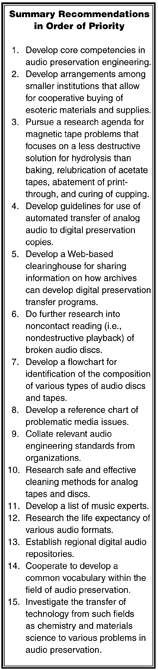
The group was also asked to assign priority for action on these recommendations. The sidebar on page 14 lists the 15 recommendations that members believed were most important, presented in order of priority
Resources/Tools Needed
- Develop a one-page flowchart that offers a series of yes/no questions to help audio preservation archivists identify the composition of various types of audio discs and audio tapes. Such a chart could be invaluable to staff of archives that outsource their audio preservation transfers. Knowing the composition of the recording at hand could significantly influence risk-assessment decisions for the recordings to be transferred (Priority #7).
- Develop a reference chart of problematic media issues, including tape brands, years of manufacture, etc. (Priority #8).
- Investigate the relevance of technology-transfer methods from such fields as chemistry and materials science to audio preservation, particularly in identifying the composition of audio discs and tapes and the nondestructive playback of discs (Priority #15).
Reference Materials
- Develop a Web site that identifies the core competencies for audio preservation engineers. This information could be distributed in video format (Priority #1; see related item below, Core Competencies).
- Develop a Web-based clearinghouse for information on how archives can develop a program of digital preservation transfer, including, for example, information on potential sources of grants for audio preservation; a resource list of experts on audio preservation and transfer; lists of equipment for audio preservation and transfer needs; and technical manuals and key specifications for obsolete and hard-to-find equipment. The resource would include guidelines for developing an audio preservation workstation, including selection of hardware, configuration of equipment, optimum wiring for signal flow, and testing (Priority #5).
- Develop a list of music experts who could be consulted for advice on problems that arise in analog audio transfer of specific types of musical content (e.g., determining the proper key so that the correct playback speed can be established). In addition, develop a source of references for issues that might arise in any audio transfer particular to specific types of musical and spoken-word content (Priority #11).
Research and Development
- Conduct research on magnetic tape problems: (1) research a better (i.e., more permanent, less destructive) solution than baking to solve the problem of binder hydrolysis of polyester tapes; (2) devise methods for relubricating acetate tapes; (3) research how to abate print-through; and 4) research cures for cupping (Priority #3).
- Do further research into noncontact reading (i.e., nondestructive playback) of broken audio discs. Great strides have been made in developing turntables that read audio discs with lasers. Other methods have shown potential for playing some kinds of broken discs. In addition, prototyping technologies might be used in “virtually” reconstructing disc grooves (Priority #6).
- Research safe and effective cleaning methods for analog tapes and discs (Priority #10).
- Research the life expectancy of various audio formats (Priority #12).
Develop tools that measure the shape, size, and wear of record grooves.
- Develop systems for automated metadata collection.
- Research error detection in large digital files through the use of embedded, noninvasive signals.
- Develop noise-reduction detection equipment. Many tapes since the 1980s have been processed for noise reduction, to the detriment of the sound. As one roundtable participant put it, “How does one detect this and mitigate it?”
Infrastructure Needs
- Develop arrangements among smaller institutions that allow for cooperative buying of esoteric materials and supplies. Given that there are fewer and fewer suppliers of phonograph styli, tape heads, and other obsolete and soon-to-be obsolete equipment, cooperative buying might yield dual benefits. First, it would make it easier for small archival organizations to afford equipment and supplies without each having to buy in bulk. Second, it might establish a stable market and provide enough economic incentive to keep some of these suppliers in business (Priority #2).
- Establish regional digital audio repositories. Although some major institutions, such as university libraries and LC, may be able to afford the care, upkeep, and digital migration associated with maintaining a digital repository, many smaller archival organizations—such as state and local historical societies and independent nonprofit music archives devoted to jazz, blues, and other forms of music—may be unable to afford to store and care for their digital preservation copies over time without cooperative arrangements with other institutions (Priority #13).
- Cooperate to develop a common vocabulary within the field of audio preservation. Roundtable participants recommended the development of an online glossary and suggested that this might be something that LC could undertake (Priority #14).
Standards
- Develop guidelines for archives on how to judge when to use automated transfer of analog audio to digital preservation copies. This is a complex risk-assessment task. Those doing automated transfers need guidelines and sources of expertise (Priority #4).
- Develop a collation of the existing relevant audio engineering standards from organizations such as AES, ARSC, IASA, and NARAS. Roundtable members recommended reviewing all international standards (Priority #9).
Developing Core Competencies in Audio Preservation Engineering
(Priority #1; see related additional #1 item on page 13, Web site, under “Reference Materials”)
Roundtable members expressed concern that in some archives, fragile audio recordings are being handled, played, and transferred for digital preservation by staff who have limited experience working with audio recordings or little knowledge about the sonic characteristics and weaknesses of various audio formats. The group strongly recommended that audio preservation transfers be done by trained and experienced audio engineers.
Participants identified a number of core competencies that an audio preservation engineer should have. Among other things, these would include the ability to
- identify the composition of audio tape and audio discs
- clean and resplice damaged splices on analog audio tape
- determine the correct stylus type for faithful playback of audio discs
Until recently, there have been few university programs to train audio preservation engineers. Roundtable participants agreed that audio preservation engineers should be trained in postgraduate audio engineering courses that include a practicum or laboratory component. They recommended that coursework be coupled with an apprenticeship with a skilled audio engineer experienced in audio preservation. “We should err toward professionalizing music archiving and music conservation,” said one participant. “If we can just get these programs into universities, this would be genuine progress.” Ideally, such coursework would include instruction in the following:
- the history of various recording media that have been used through the years.
- hands-on exposure to recording media of past and current generations
- recording media science and preservation
- the nature of computer data files, metadata, data integrity, data management systems, information retrieval systems, and data migration
- how to recognize failure modes of various media and the proper techniques to mitigate those failures
- proper storage environments for various recording media
- the proper functioning of equipment and techniques for equipment repair, maintenance, and testing
- environmental hazards of handling various materials
- cataloging issues that pertain to audiovisual material
- curatorial issues that pertain to audiovisual material
- curatorial issues that relate to audio and collections (e.g., how audiovisual materials might be integrated into a large paper archive)
- intellectual property issues that pertain to audiovisual materials
- basic business (“Business 101”)
- the ethics of preservation
Conclusion
As new audio technologies evolve and supplant older ones, we risk losing decades of spoken-word and musical recordings that are valuable not only as commercial products but also as cultural touchstones that document who we are, what we feel, and how we experience our world. At present, there are both audio engineers and equipment capable of transferring even the oldest analog recordings safely to digital. But this will not be true for long. As one roundtable participant noted, “The pool of expertise is shrinking every day.” If key technical knowledge is not passed along soon, thousands of recordings may not be accessible to America’s listeners 20 or 30 years from now.
Roundtable members agreed that sharing their expertise with colleagues in audio archiving and audio engineering, both now and in the future, is of vital importance. Participants noted that some of the leading associations in the audio field—such as AES, ARSC, IASA, and NARAS—have unilateral efforts afoot that may lead to some progress in developing standards for digital preservation. They agreed that more communication across these groups—through the Web and group meetings—should be encouraged to facilitate the sharing of information and recommendations.
FOOTNOTES
1 Holland, Bill. 1997. Upgrading Labels’ Vaults No Easy Archival Task. Billboard (July 19): 99.