
The Ampex Recording Media Corporation, a U.S. magnetic tape manufacturer, has developed many informational and training materials about magnetic tape. The “Guide to the Care and Handling of Magnetic Tape” is reproduced here with the permission of the Ampex Recording Media Corporation. Additions, changes, and comments by NML are shown in square brackets [ ]. Some of the sections of this document deal with recorder aspects that may be beyond your control, such as wind speed and tension, if you are using a simple VHS, cassette, or reel-to-reel audio deck. However, these sections still contain useful information on what to look for as signs that the tape is damaged or needs to be copied. All sections of the original document are included for completeness, but not all sections may be appropriate for your particular tape collection.
|
Cleanliness
Cleanliness is important because minute debris can cause loss of reproduced signal by disturbing the intimate contact necessary between the tape surface and the reproducing head. Figure 9 shows typical dimensions of common contaminants in the context of significant tape to head separation. A separation less than 1/10th of the diameter of a smoke particle will cause a 12 dB loss, reducing the signal to 1/4 of the proper amplitude.
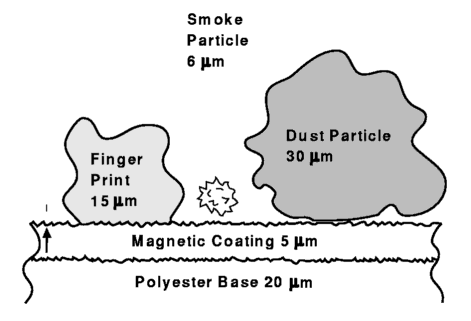
Figure 9. Tape Debris. (Source: Ampex. Reprinted with Permission.)
For analogue recording, especially audio recording, the effects of dirt and debris are much less important than for high density digital recording and video recording. Relatively severe dropouts will be unnoticed in analogue hi-fi reproduction and even worse dropouts will not impair the intelligibility of speech.
Dropouts are much more important in instrumentation data recording and any form of high density digital recording. If the signal losses are sufficiently severe to overwhelm the error correction, data errors may result.
In video recording, very short duration dropouts appear as irritating flashes in the picture, and in this case, perhaps unusually, the eye is more critical than the ear. For any type of recording, things are not as difficult as they appear because spacing due to debris is confined to only a small part of the track width, but the message for tape care is clear. However, most physical tape damage occurs when tapes are being loaded on a recorder or during handling before or after loading. It is, therefore, preferable that tapes be kept clean to avoid the need for special cleaning that involves extra handling and passage through additional mechanisms. For general purpose tapes, a class 10,000 clean room environment (less than 10,000 0.5 mm particles per foot) is a good aim. High density digital recording may benefit from cleaner conditions.
The worst contaminants, which should never arise, are sticky residues from improper tape end fixing tabs or elsewhere. Special end retaining tape or tabs have non-oozing clean pealing adhesive.
Stray Magnetism
This is less of a problem than often thought. Devices such as walk-through metal detectors use small fields that have absolutely no effect. Hand-held detectors are best avoided as high local fields may be present. X-rays have no effect on unrecorded or recorded tapes. Similarly, radiation from radar antennas can be disregarded, unless the field strengths are sufficient to injure people. [Some detectors used to screen luggage in airports use powerful magnetic fields that may partially erase recorded information on tapes. These devices are used in some European airports.]
It is prudent to keep tape away from transformers, heavy electrical machinery, [and other very strong magnets]. Magnetizing forces of the order of 500 A/m and above can cause partial erasure and/or increase print through in the case of recorded tape. Such fields may put low frequency (LF) noise on unrecorded tape. This can be removed by bulk-erasure. The risk of increased print through applies to alternating fields that can act as a bias, encouraging layer-to-layer printing.
Magnetic field problems are very rare, even for tapes shipped internationally without special precautions. The best protection for shipping is a minimum of 50 mm [2 inches] of nonmagnetic material all round. The inverse square law ensures that the fields from even heavy electrical equipment will not affect tape at 50 mm [2 inch] distance. Metallic boxes and foils offer no useful protection against stray fields but may help exclude adverse environments.
Tape Handling
General
Cassettes provide good protection for the tape inside. Cassettes should be returned to their library boxes for additional protection when not in use.
The protection offered by reels can be improved if wrap-around collars fitting around or between the flanges are used. Such collars prevent the flanges deflecting and pressing against the edge of the tape; they also help exclude dust and retain the tape end, avoiding the risk of contamination with glue from unsatisfactory retaining tabs.
[Shock, such as dropping the tapes, should be avoided.]
Tape edge quality
Tape is slit to precise widths with smooth straight edges. These qualities must be preserved if the tape is to perform well, [since most recorders edge guide the tape].
Modern recorders use narrow tracks. [If a tape edge is nicked, dented, bent or stretched] the recorder head [will not properly track over the recorded signal (mistracking)]. Bent or nicked reels, therefore, should be promptly discarded before significant tape edge damage results.
If an uneven tape pack is noted within a cassette, it may be appropriate to copy any valuable data for the same reason.
Tape pack/wind quality
Tape is least vulnerable to external damage when wound in a smooth, even pack. Popped strands, where a few turns of tape stand away from the majority, are very easily damaged and should be avoided by using good quality tape and properly adjusted recorders.
Wound tape packs tend to loosen at low temperature (the tape thickness shrinks faster than the length). [This can also occur if the tape has reached high temperature and/or humidity and is brought back down to access conditions]. Vertical storage prevents pack slip under such conditions. Supporting reels by their hubs ensures the flanges are not deflected. In the ideal case, the flanges will then not contact the tape.
[Flange packing is a condition that occurs when the tape is either wound up against one flange by a poorly aligned recorder, or has fallen against the flange due to a loose wind and flat storage. Flange packing often leads to damaged edges from the tape scraping against the edge of the flange as it unwinds through the recorder or winds back to the reel. When a poor wind with popped strands is also present, the strands that stick out of the pack can be severely bent when the tape is flange packed.]
Embossing
Reels should have smooth tape take-up surfaces. Even small bumps close to the hub will produce impressions in the tape repeating for several tens of meters. This embossing effect applies for lumps as small as 30 mm [1.2 mil; 0.0012 inch] high, and the impressions produce measurable tape-from-head separation. Note that even well-made splices stand higher than 30 mm so the embossing effect applies.
A wrinkled tape end on the hub can cause similar problems. A wrinkled or frayed end at the beginning of a tape is likely to deposit debris in the recorder tape path before embossing the tape as it winds onto the take-up reel.
Winding speed and tension
As indicated above, a smoothly wound pack is always desirable. A nominal winding tension in the region of 2.2 N [8 ounces] is appropriate for 25.4 mm [1 inch] wide tape with nominal thickness 25 mm [1 mil; 0.001 inch]. For other widths and/or thicknesses, the tension may be adjusted pro-rata. At slow winding speeds (< 381 mm/s [15 inches/sec]), very little air is trapped in the pack as it is wound, and there is a negligible air lubrication effect. In these conditions, lower tension may be desirable.
Excessive tension (at any speed) leads to a tape pack showing radial lines known as spokes. These radial lines result from the pressure from outer layers in the pack compressing the inner layers so that the turns develop a small kink. These kinks align radially and appear as a spoke [when you look through the flange at the edge of the tape].
In severe cases, the periphery of the tape pack may lose its smooth round form and become lumpy. A tape showing any such signs of distress should be rewound immediately, ideally at a low speed (e.g., 760 mm/s [30 inches/sec]) and any valuable data copied. The tape may return to normal, but there is a risk of the edges having been stretched more than the center, which leads to wrinkled edges and subsequent tracking and tape-to-head contact problems.
Several different winding tension control systems are popular. Most tape leaving the factory is wound with constant torque. Many recorders wind with constant tension. There is also the so-called programmed winding tension advocated by several U.S. Government agencies. In this case, the tape is wound with low tension close to the hub. Increased tension is applied midtape and then the tension reduces again as the outer diameter is approached. A plot of tension (vertical axis) versus tape length (horizontal axis) gives rise to another name for this technique, which is the bathtub curve approach.
This special technique yields a pack with certain types of tape that survives a particular sequence of temperature and humidity cycles very well, but either constant tension or constant torque winding is perfectly satisfactory for normal applications and storage conditions.
Periodic rewinding
For long-term storage, it is helpful to rewind tapes at an interval of not more than three years. This relieves tape pack stresses and provides early warning of any problems.
Rotary Head Recorders
Tape scratches and head clogging
All the foregoing considerations apply equally to stationary head and rotary head [VHS; 8mm] recorders; however, the much greater head-to-tape speed associated with the latter can lead to special problems if the tape becomes scratched. Tape scratches may be inflicted by damaged heads or a sharp surface somewhere along the tape path.
Scratches can also be caused by mobile debris reaching the spinning head area. In such cases, high temperatures can result at the head-to-tape interface, and a blob of molten debris can become welded to the head. This solidifies and, as it spins on the head, inflicts more damage on the tape. A head with such a damaging attachment neither records nor reproduces properly and is said to be clogged. It is, therefore, very important to be scrupulous in following the cleaning procedure recommended by the recorder manufacturer.
If there is any suspicion of tape scratching, the recorder tape path and heads should be cleaned immediately to avoid risk of damage to other tapes. Similarly, a scratched tape should be taken out of use as soon as possible to avoid the risk of clogged heads and damage to other tapes. Once a tape is scratched, its surface integrity is lost, and it will tend to clog on even the most perfect recorder.