Leadership
The library of the future will require information professionals who have both discipline-specific and technical skills. CLIR’s leadership activities are designed to cultivate a large cadre of individuals who are prepared to work in collaboration with faculty and administrators to design information products and services appropriate for the new environment. CLIR believes that the next generation of leaders of information organizations must think and work in a fundamentally different way.
Frye Leadership Institute
In an effort to cultivate new leaders who are more mindful of the interdependencies of faculty, librarians, and information technologists, CLIR, EDUCAUSE, and Emory University launched the Frye Leadership Institute in 2000. The third class of the Frye Institute completed the curriculum in a two-week residential experience at the Emory Conference Center from June 214, 2002. The group included 43 participants selected from 130 applicants. Thirty-seven leaders in higher education participated as faculty.
During the first week, presidents, provosts, educational policy experts, and other administrative officers offered their views on the state of higher education today and the challenges confronting colleges and universities. In the second week, faculty, researchers, financial officers, library and information technology leaders, and training specialists addressed such issues as intellectual property and copyright, technological advances in teaching and research, scholarly communication, and funding. In separate skill-building sessions, participants worked on enhancing their oral and multimedia presentation skills and personal leadership styles.
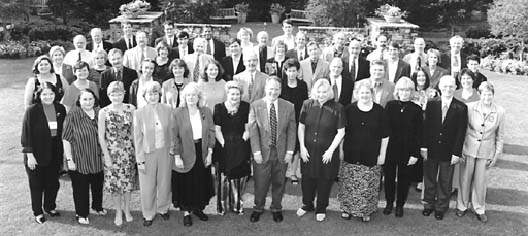
Frye Institute participants, June 2002.
For a list of participants, click here.
During the year, each Frye Institute participant will work on a practicum project on his or her home campus that involves collaboration with other information staff of the institution.
Nearly 150 librarians, information technologists, and teaching faculty from the full range of types of academic institutions have now completed the Frye Leadership Institute. The goal is to build a cadre of some 500 individuals by the end of the decade. This aspiration is reachable, thanks to the Robert W. Woodruff Foundation, which has generously provided funds for the first several years of the program. The Andrew W. Mellon Foundation, the Institute of Museum and Library Services, and the Patricia Battin Scholarship Fund also provide support for individual participants.
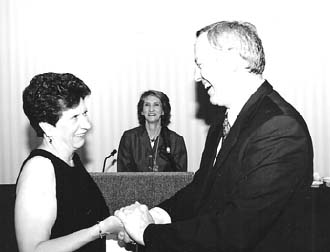
Co-dean Richard Detweiler presents a Frye Institute certificate to Kathleen Kurosman of Vassar College. Looking on is Institute co-dean Deanna Marcum.
Academic Librarians Advisory Committee
The Academic Librarians Advisory Committee (ALAC) was formed in 2000 to advise CLIR about issues of particular importance to college and midsize university libraries. This year, the ALAC addressed three issues: the inclusion of electronic content and library services in courseware management systems; the changing role of public services in libraries; and the need for information on scholarly communication issues for presidents and provosts.
In January, the committee hosted a meeting of librarians, major courseware management system developers, and integrated library system developers, along with developers from the Open Knowledge Initiative and a representative from the Coalition for Networked Information. The meeting helped inform the group about enhancements being planned for courseware development and gave librarians a chance to share their views on software development needs from the perspective of content and services. Group members identified issues for further study and began to recruit libraries to undertake small projects that would facilitate inclusion of library-managed content and services in courseware. The group has identified two projects that will be initiated this year on two liberal arts college campuses.
The second area the committee addressed this year was the changing role of public services in libraries. After conducting informal research on other projects in this area, the group reached a consensus on the part of this issue it would like to address, namely, outreach and promotion of library resources and services.
In their effort to better inform presidents and provosts about issues of scholarly communication, committee members contributed to the development and evaluation of CLIRinghouse, described in the following section.
Outreach to Campus Leaders
Although CLIR develops many publications for librarians and other information professionals, it also seeks to provide insight and information for a broader audienceparticularly leaders of colleges and universities. This broadened focus was taken at the request of campus librarians who wished to engage their presidents and provosts in issues raised by new information technologies but found busy executives hard to reach. In August 2001, CLIR launched CLIRinghouse, a one-page bulletin that provides, as its masthead says, “quick insight into information-investment issues for presidents, CAOs, and other campus leaders.”
Over the past year, with financial assistance from The H. W. Wilson Foundation, CLIR sent 10 issues of CLIRinghouse free of charge to about 4,400 executives and 2,000 head librarians in colleges and universities throughout the United States. The bulletins offered insight about such things as creating digital collections, preserving both digital resources and traditional collections, analyzing use of online materials, building portal services to facilitate use, integrating course-management computer programs with library resources, and evaluating digital information investments. More than 60 percent of the executives and more than 80 percent of the librarians who responded to a survey after the ninth issue said they wished to continue receiving CLIRinghouse. Accordingly, CLIR plans to continue publishing the bulletin every two months for at least another year.
CLIR’s president and staff published articles in several publications read by academic administrators and faculty members. Articles promoting attention to scholarly resource preservation were accepted by the Chronicle of Higher Education and by Trusteeship, the magazine of the Association of Governing Boards of Universities and Colleges. Two online periodicalsD-Lib Magazine and RLG DigiNewspublished articles by CLIR staff. EDUCAUSE Review asked CLIR’s president to become editor for two years of a new column about “e-content” that has been developed to help fulfill the magazine’s mission to “explore the impact of information technologies on higher education.”
First Meeting of Chief Information Officers
Many small academic institutions are beginning to merge library and technology support into a single unit. Several leaders of such units expressed to CLIR their need for a place where their concerns could be treated as an integrated whole. In May, CLIR convened a meeting of 16 liberal arts college chief information officers to identify issues of concern related to organization, planning, and development and staffing. The meeting was productive, and CLIR will work with the group in the coming year to develop an agenda.
Zipf Fellowship
Miles James Efron, a Ph.D. student in information science at the University of North Carolina, Chapel Hill, was named the sixth recipient of the Zipf Fellowship. Mr. Efron’s research seeks to explain how statistical methods may be used to map information spaces to facilitate access to information. Mr. Efron’s professional career has focused on research and development of information retrieval technologies for user-maintained digital libraries.
The Zipf Fellowship is awarded annually to the student in some field of information management or systems who best exemplifies the ideals of Al Zipf, the information science pioneer for whom the award is named.
Battin Scholarship
The third annual Patricia M. Battin Scholarship was awarded to Candice Scott, director of W. M. Logan Library and Information Technology Services, Schreiner University. The Battin Scholarship provides tuition for an individual who has been selected to participate in the Frye Leadership Institute, but whose institution cannot afford to cover the costs. The scholarship is made possible by contributions from friends and family of Patricia Battin, former president of the Commission on Preservation and Access.