The Evidence in Hand: Report of the Task Force on the Artifact in Library Collections
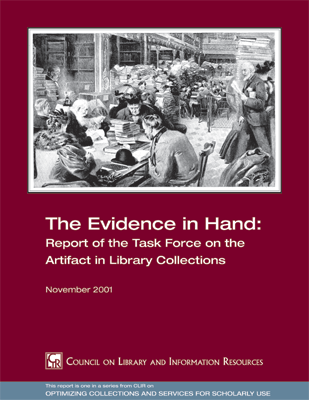
November 2001
Copyright 2001 by the Council on Library and Information Resources. No part of this publication may be reproduced or transcribed in any form without permission of the publisher. Requests for reproduction should be submitted to the Director of Communications at the Council on Library and Information Resources.
Cover image: “Scene in the Old Congressional Library, Washington, D.C., Showing Present Congested Condition,” by W. Bengough. The illustration appeared in Harper’s Weekly on February 27, 1897. CLIR is grateful to The Making of America Digital Collection, Cornell University Library, for providing the scanned image.
- 1.1 The Charge
- 1.2 The Work of the Task Force
- 2.1 Selection for Preservation of the Original
- 2.2 Frameworks for Determining Value
- 3.1. The Changing Features of the Artifact
- 3.2. Print/Paper
- 3.2.1 The Relative Stability of Imprints
- 3.2.2 Evaluation of the Artifact and Selection for Preservation
- 3.2.3 Creating Surrogates: Filming versus Scanning
- 3.2.4 Responsible Retention Policies
- 3.3. Audiovisual
- 3.3.1 Sound and Light as Artifacts
- 3.3.2 Still Images
- 3.3.3 Moving Images
- 3.3.4 Recorded Sound
- 3.3.5 Broadcast Media
- 3.4. Digital
- 3.4.1 Artifacts and Artifactual Value in the Digital Realm
- 3.4.2 Digital Surrogates
- 3.4.3 Access
- 3.4.4 Born-Digital Materials
- 3.4.5 Preservation of Digital Information
- 3.4.6 Copyright: A Barrier to Preservation?
- 4.1. The Five-College Library Depository
- 4.2. The Emperor Jones
- 4.3. Preserving Oral Traditions
- 4.4. JSTOR
- 4.5. The Rossetti Archive
- 5.1 Principles of Good Stewardship
- 5.2 Best Practices for Preservation of the Artifact
- 5.3 Strategies for Specific Formats
- 5.4 Recommendations
- 5.5 Areas for Further Research
- REFERENCES
- APPENDIXES
- I. Current Library Practices in Collection Development and Preservation
- II. Charge to the Task Force
- III. Selection for Preservation Criteria from RLG, Cornell, and Harvard
- IV. Expenditure Trends in ARL Libraries, 19862000
- V. Non-Print Holdings in ARL University Libraries
- VI. Comparative Costs for Book Treatments
- VII. National Recording Preservation Act of 2000
Executive Summary
The “information explosion” sparked by digital technology has fostered an increasing awareness of the sheer mass of information available today in a variety of media, from traditional formats such as paper to the more recent film, optical, and magnetic formats. Institutions charged with collecting, storing, preserving, and making accessible recorded information are struggling to keep pace with the growth of information production, even though their brief is to collect only a portion of what is published and an even smaller portion of what is produced and disseminated in unpublished form. With so much information produced, how do members of the research community-scholars and teachers, librarians and archivists, and academic officers who support their work-distinguish between what is of long-term value, what is ephemeral, and what of that ephemera is valuable for the preservation of a rich historical record?
Libraries have struggled with these questions for a long time, but the issue of how to understand and protect the value in research collections, in particular in the original, unreformatted materials in physical formats that abound in libraries and archives, is more urgent than ever. The Council on Library and Information Resources convened a task force of scholars, academic officers, librarians, and archivists to investigate the role of artifacts-original, unreformatted materials-in libraries and archives as these institutions are creating digital collections and services to serve research and teaching functions. The task force members were asked to articulate a general context or framework for formulating and evaluating institutional policies on how best to preserve and make accessible artifactual collections and how to ensure their continued access for research and teaching needs, however those needs evolve.
The task force was charged to answer specifically these questions:
- What qualities of an original are useful or necessary to retain in their original form? Under what circumstances are original materials required for research?
- When is it sufficient and appropriate to capture intellectual content through reformatting and not necessarily retain the original?
- Which preservation options provide the most appropriate and cost-effective means of preserving the original?
- From both custodial and scholarly perspectives, what are the advantages and disadvantages of these various preservation options?
Task force members addressed the needs of print and paper-based collections; of audiovisual materials, including still and moving images, recorded sound, and broadcast media; and of digital formats, both those created from analog sources and those that are created and exist exclusively in digital form.
The challenges to preserving artifactual collections are formidable. Artifacts are at risk because they are produced in high quantity; because they are recorded onto unstable media that decay over time; and because the economics of preservation result in preservation needs of collections competing less and less successfully with the access needs of users. Moreover, developing priorities for preservation actions on the basis of the research value of an object is challenging because of the unknown and unfixed values of artifacts. The dynamic nature of intellectual inquiry increases demand for some types of sources while neglecting others, and competition among communities of interest can result in difficult trade-offs.
Despite these challenges, a number of critical research functions will continue to depend on access to the original. The task force found that preservation budgets in research libraries have been flat-in real terms declining-since 1994, and that they often fail to meet the preservation needs of artifacts. The attention given to increasing access through digital reformatting has the potential to eclipse the preservation needs of artifacts and to preoccupy the attention of the research community. The needs of audiovisual materials seem particularly serious, given their sheer number, the fact that relatively few institutions are collecting them in original form, and the fact that preservation issues relating to these media are difficult and expensive to address. Scholars’ general lack of awareness of the value and endangered nature of these materials leaves them with few advocates for preservation resources.
The task force looked at traditional criteria used in selecting for preservation-age, rarity, associational value, evidentiary value-and found these criteria still valid. Because artifacts of evidentiary value often have little market value and are found in multiple copies, decisions about their treatment and retention are often contested; for this reason, the task force focused chiefly on these items. Artifactual collections that are paper-based or audiovisual have evidentiary value to the extent that the original manifestation can attest to the originality, faithfulness (or authenticity), fixity, and stability of the content. When the items are reformatted onto newer media for preservation or other purposes, those qualities inalienable to the original may be lost. When that is the case, the artifact should be retained.
The report deals in detail with the ways in which artifacts and their physical frailties affect their research value-originality, faithfulness, fixity, and stability-over time and with how libraries can minimize the risk of unacceptable loss of that value. It investigates the specific issues around selected media, such as paper-based printed matter, moving image and recorded sound materials, and objects that exist in digital form, and points to two key strategies currently in use in libraries that can be scaled up to deal with a problem of this magnitude.
The first strategy is preventive maintenance, which most often entails storing items under optimal conditions to retard rates of natural decay. Prevention also includes such techniques as deacidifying items printed on wood-pulp paper, stabilizing bindings and encasing fragile items, and improving care and handling techniques for all library materials.
The second strategy is the use of surrogates to reduce the stress of handling. For research purposes, digital surrogates in particular were found to be quite acceptable, and were even preferable to the originals in a number of cas es. Surrogates, especially when networked, have the added benefit of increasing access to an item and of providing convenience of access to items housed at distant or disparate locations.
The task force acknowledges that both strategies have their drawbacks. For preventive measures, the chief drawback may be that optimal storage conditions are created only in closed-stack environments. This practice has great benefit to the collections but can affect the ways in which researchers gain access to them. With the use of surrogates, the drawbacks from the user’s point of view depend chiefly on the type of surrogate created, with digital scans and preservation photocopying being preferred to microforms. The larger problem may be that, as preference for the convenience of surrogates grows in the digital library, the continuing preservation needs of the source artifacts may be eclipsed by the resource needs of creating and maintaining digital files, the long-term costs of which are unknown.
Given the size of the collections that are of potential research value over time, the desirability of ensuring that a meaningful number of them are preserved for present and future access purposes, and the desirability of maintaining the richest possible historical base of cultural and intellectual resources, the task force concluded that librarians and scholars need to build economies of scale into preservation strategies.
Specific recommendations for these economies of scale for different media follow.
Print/Paper
- Establish regional repositories to house and provide proper treatment of low-use print matter. These repositories would provide access to artifacts aggregated from different institutions under terms to be worked out. Such repositories might begin by taking in journals and monographs that are widely available in digital form.
- Convene a national group to investigate the establishment of archival repositories that would retain a “last, best copy” of American imprints.
- Build interinstitutional networks of information sharing about the status of artifacts and delegation of responsibilities for caring for them. These networks would obviate unwanted duplication and encourage libraries to take responsibility for the preservation of their most important or rarely held materials. These networks would include a registry of digitized collections that has information about where the originals are located, who has responsibility for them, and under what terms they may be used.
Audiovisual
- Extend the reach of the National Film Preservation Plan sponsored by the National Film Preservation Board to continue preserving historically significant films and, in particular, to serve the needs of noncommercial films.
- Implement and extend the reach of the national plan to preserve television and video that has been proposed in a study by the Library of Congress. The U.S. Congress has authorized a similar assessment and plan for recorded sound.
- Encourage scholars and librarians to identify important media collections in need of preservation and set priorities for treatment.
- Urge scholars and librarians to develop controlled vocabularies and common descriptive standards for the intellectual and inventory control of media collections.
Digital
- Develop sound criteria for selecting collections to digitize.
- Develop benchmarks and minimal-level standards for capture and metadata, and document the specifications used.
- Create registries of digitized artifacts to document what has been converted and how, and to facilitate access to the source materials as well as to the surrogates.
- Develop and use nonproprietary formats for creating born-digital objects to facilitate the creation of preservable digital files.
- Urge scholars and librarians to develop criteria for selecting born-digital materials to be preserved or managed for long-term access.
- Continue to research and develop methods for preserving digital files.
Task force members were asked to look only at those materials around which a debate could arise on retention of the original. They recognized that the preservation needs of special collections and rare-book collections are also great and should be addressed in any preservation strategy at both the local and the national levels.
Good stewardship of the intellectual and cultural assets in libraries and archives is the responsibility of all members of the research community, not merely of the librarians and archivists who have immediate custody of the collections. The preservation challenge cannot be deferred or deflected, for what is lost by the present generation cannot be retrieved by the next.
Stephen G. Nichols
Chairman, Task Force on the Artifact in Library Collections
Johns Hopkins University
Abby Smith
Director of Programs
Council on Library and Information Resources
Task Force Members
Stephen G. Nichols, Chairman
James M. Beall Professor of French and Humanities
Chair, Romance Languages
Johns Hopkins University
Francis X. Blouin
Director
Bentley Historical Library
The University of Michigan
Bernard Cerquiglini
Director
Institut national de la langue française
Rebecca S. Chopp
Provost and Vice President for Academic Affairs
Emory University
Sheldon Hackney
Professor of United States History
University of Pennsylvania
Charles Méla
Université de Genève
James J. O’Donnell
Vice Provost, Information Systems/Computing
University of Pennsylvania
Henry Petroski
A. S. Vesic Professor
Department of Civil Engineering
Duke University
Abby Smith
Director of Programs
Council on Library and Information Resources
Sarah Thomas
University Librarian
Cornell University Library
John Unsworth
Director
Institute for Advanced Technology in the Humanities
University of Virginia
Nancy Vickers
President
Bryn Mawr College
Steven C. Wheatley
Vice President
American Council of Learned Societies
Karin Wittenborg
University Librarian
University of Virginia
Pauline Yu
Dean of Humanities
College of Letters and Science
University of California at Los Angeles